
Developing scientific framework
Neural Attunement
A post acute electrophysiological framework for identifying a candidate neural state, testing its regulatory properties under standardized perturbation, and classifying functional outcome independently.
Public and evolving
The scientific problem
Measuring neural regulation after the acute effects subside.
Psychedelic research has developed several accounts of afterglow, reopened plasticity, canalization, and recalibration. Neural Attunement addresses a narrower problem: whether the post acute period contains a prospectively identifiable neurophysiological configuration whose regulatory properties can be tested.
Persistent resting markers can identify a candidate configuration. They cannot establish that the configuration regulates. That designation requires altered response dynamics under standardized challenge, coupled within person to expression of the candidate state.
Conceptual model
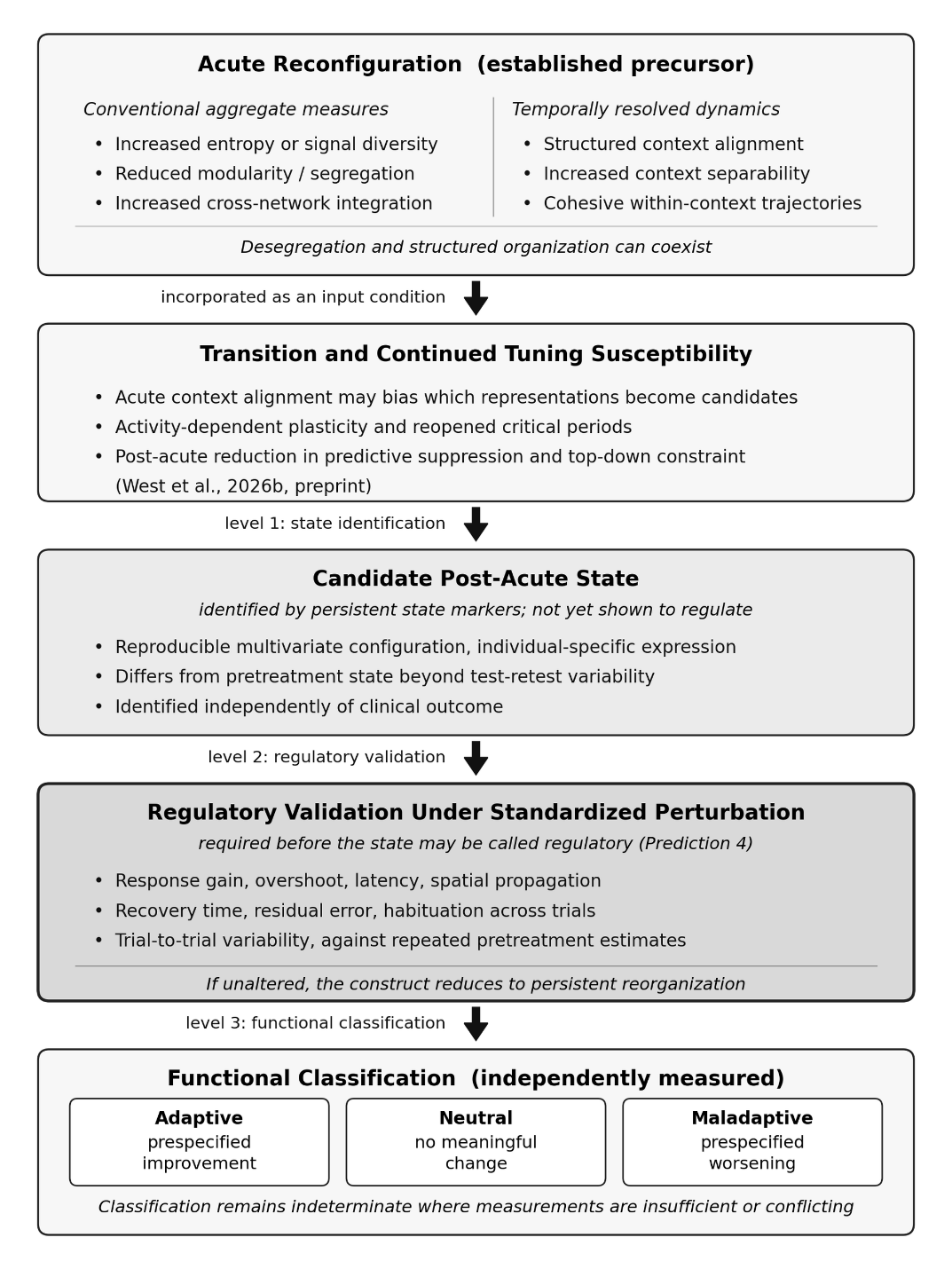
Three levels of evidence
State identification, regulatory validation, and functional classification are separate levels. A reproducible state carries no presumption of benefit.
Figure from the current Neural Attunement manuscript. It is a conceptual model and does not display empirical outcome data.
Measurement architecture
Rest, perturbation, response, recovery.
Resting measures establish a reference. A standardized probe then tests what the system does, how the response unfolds, and whether it returns efficiently.
Rest
Establish the pretreatment and post acute configuration.
Perturbation
Apply a standardized reward, threat, cognitive control, or direct cortical probe.
Response
Measure reactivity, amplification, timing, and propagation.
Recovery
Measure return trajectory, damping, residual error, and adaptation across trials.
Reading the response
Dimensions of regulatory dynamics
Amplitude
Magnitude of the response to a defined challenge.
Latency
Time between perturbation and measurable response.
Gain
How strongly input is amplified or damped.
Propagation
How activity spreads across regions or networks.
Recovery
Time and trajectory of return following challenge.
Residual error
What remains after the system should have recovered.
Habituation
How response changes across repeated trials.
Variability
Trial to trial stability or dispersion.
Coupling
How components change together during response and recovery.
Effective connectivity
Directed influence among measured system components.
Falsifiable predictions
Six claims that discriminate the framework from simpler alternatives.
Failure carries graded consequences. Some results would reject the state or regulatory construct. Others would narrow the model’s scope.
- 01
Convergent neural markers form a reproducible multivariate post acute state representation.
- 02
Pretreatment electrophysiology moderates the direction or magnitude of later marker change and functional response.
- 03
Individualized baseline dependent profiles outperform a fixed directional signature in held out data.
- 04
The candidate state shows altered response dynamics under standardized challenge, and those dynamics covary with expression of the state.
- 05
Acute context alignment relates to later post acute reorganization, with causal effects requiring experimental manipulation.
- 06
Classifier defined state membership moderates the effect of structured input beyond elapsed time since administration.
Measured
Current empirical anchor
Available longitudinal human work following magnesium ibogaine reports persistent post acute neurophysiological changes. The current manuscript treats those findings as a candidate cohort level signature, not a universal individual endpoint.
Proposed
What remains theoretical
The regulatory designation, individualized state classification, state defined tuning window, adaptive functional meaning, and cross compound generalization remain unestablished.
Decisive test
What could reject it
If independent studies find no reproducible post acute configuration beyond measurement and control variation, the state construct fails. If response dynamics do not change, the regulatory interpretation fails.
 Public preprintZenodo · DOI 10.5281/zenodo.20549391