

An interactive research atlas
Psychedelics and
the Reward System
How the brain assigns value, and what psychedelic research can tell us
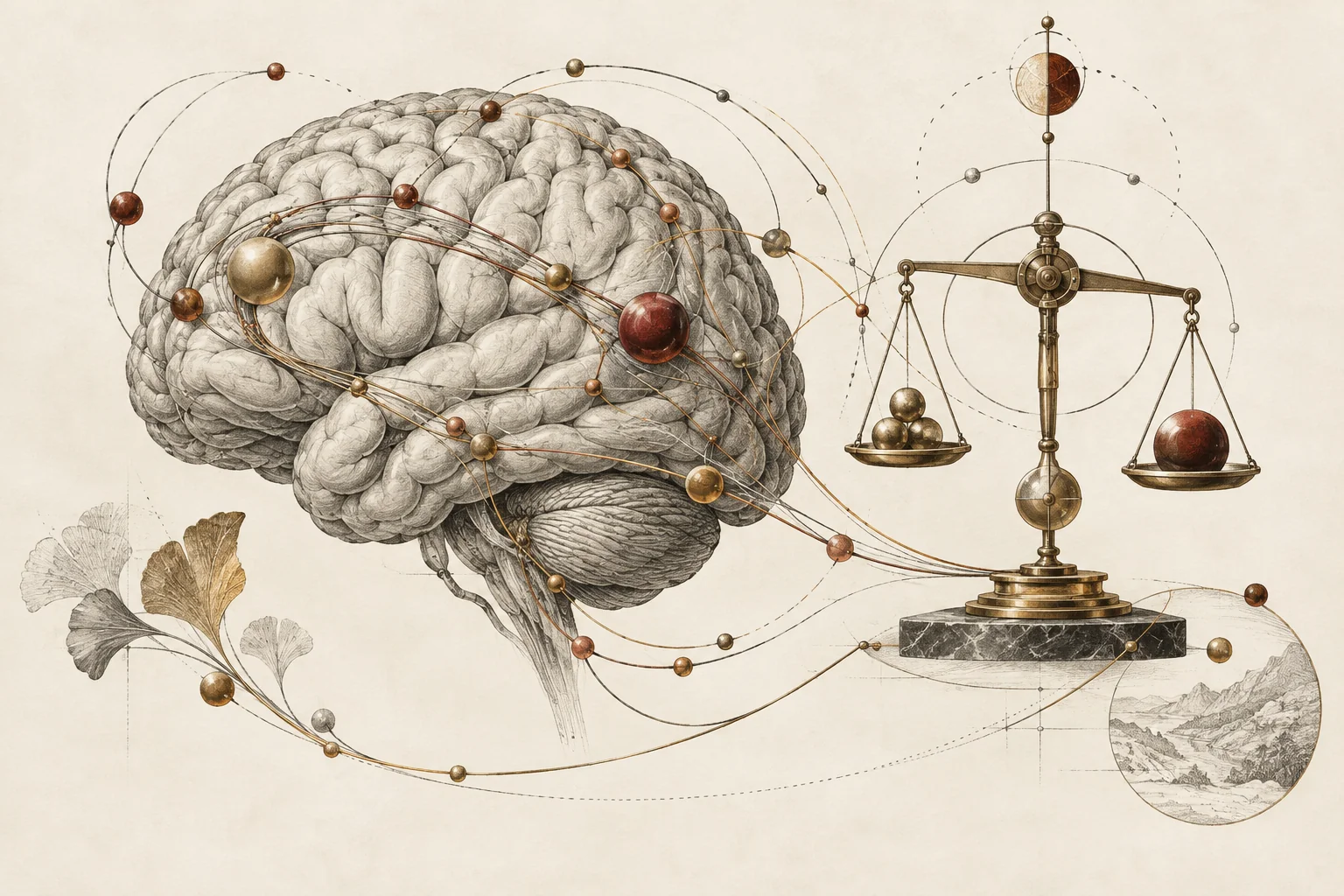
How does the brain decide what is worth pursuing?
Food, connection, relief, and opportunity all acquire value through a changing nervous system. Explore the circuits involved, compare the compounds studied, then test those ideas through everyday experiences.
Explore the compoundsBuild the reward systemInteractive demonstrations use conceptual models. Empirical findings, proposals, and open questions are labeled separately.
Six compounds, distinct profiles
How the compounds differ.
Compare the compounds’ molecular targets, actions, time courses, and reward findings.
Classic serotonergic psychedelic
Psilocybin
A prodrug becomes a serotonin receptor agonist.
The active molecule is psilocin. Its serotonin receptor profile is broader than 5-HT2A, without the same dopaminergic and adrenergic binding pattern seen with LSD in comparative assays.
Serotonin receptor
5-HT2A
Agonist activity is central to the psychedelic effect. This does not mean the receptor alone explains later clinical change.
Selected interactions, not an exhaustive binding profile or a potency ranking.
Acute distress, headache, nausea, and psychiatric adverse events are relevant. Trial selection and support limit generalization to unsupervised use.
Build the reward system
A distributed system, not a pleasure center.
Start with the midbrain and add the structures that help turn signals into value and action. Move between the anatomical reference and the circuit view as the system grows.
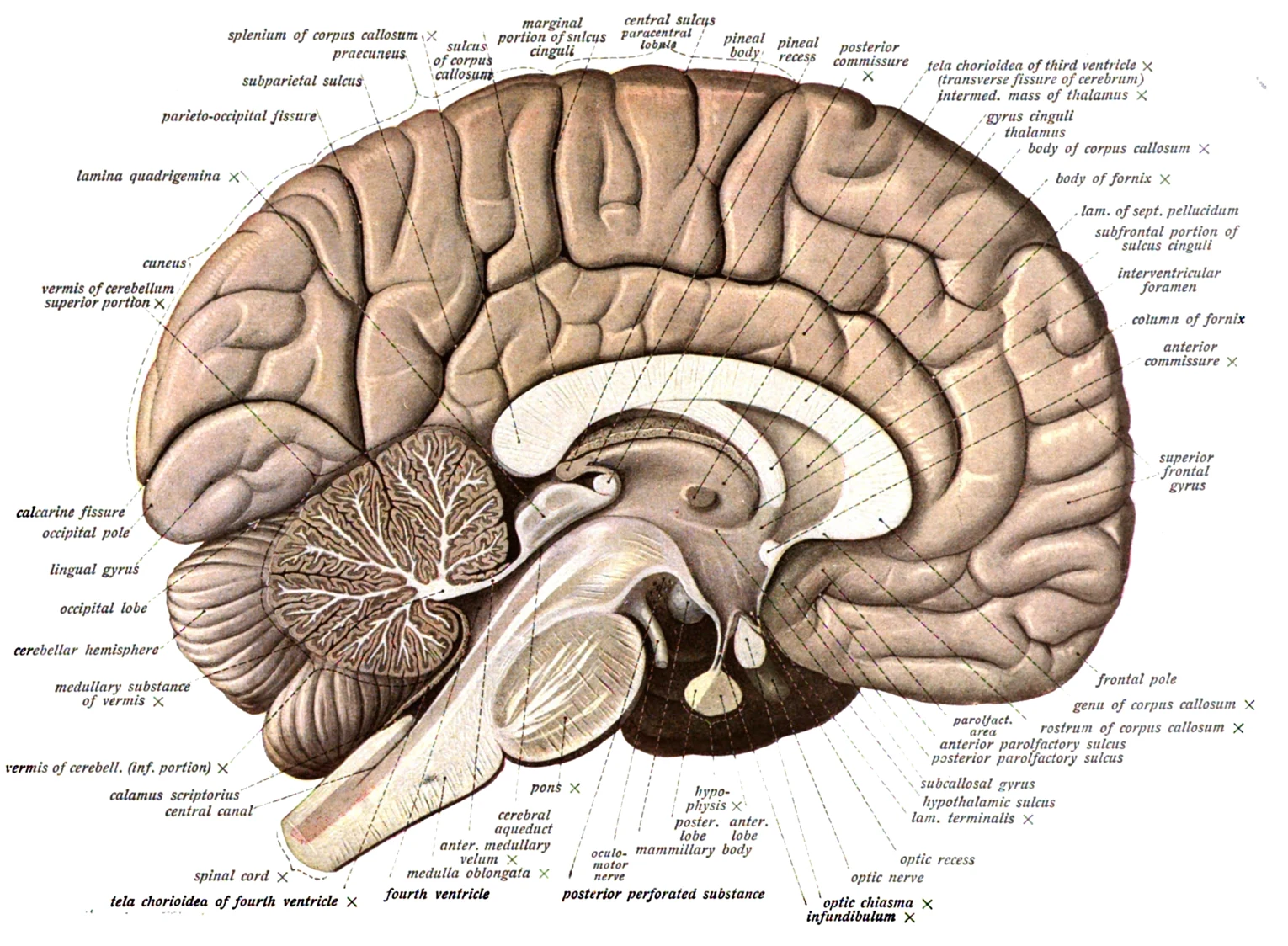
Midbrain
Ventral tegmental area
Dopaminergic and other cell populations contribute to motivation, learning, and responses to salient events. Its projections are one component of a distributed system.
Selected connections in this model
No connections for this structure are shown in the current view. The model includes only selected projections.
Across diagnostic boundaries
Shared dimensions do not erase distinct disorders.
Motivation, learning, pleasure, threat, and control can be relevant across conditions. Their presence does not make those conditions one disease, or imply that one compound treats them all.
Cue motivation, reinforcement, habit, and negative reinforcement
Substance use disorders
Incentive sensitization and allostatic accounts distinguish pursuit from pleasure and explain why relief can become a powerful reinforcer.
Where the inference stops
Mechanisms differ across substances, exposure histories, and individuals. These accounts are not interchangeable and do not explain every case.
Symptom language and mechanism
Impaired control, continued use despite harm, and craving are broad diagnostic themes. A powerful urge need not mean greater enjoyment.
The symptom descriptions paraphrase broad DSM concepts for education. They are not diagnostic criteria, a checklist, or an assessment. A symptom can arise through several mechanisms; a mechanism can matter across diagnoses.
Allostasis and opponent processes
Repeat the event. Watch the reference move.

In addiction models, repeated exposure can recruit opposing processes and change what relief or reward means relative to the current state.
This is narrower than saying every pleasure lowers a universal happiness set point. A temporary response, a persistent adaptation, and a clinical disorder are different claims.
Begin with the original reference.
In this model, increasing history changes both the reference and the context for interpreting the response. It does not forecast how quickly any individual develops or recovers from an adaptation.
History dependence
Take two routes to the same input.
Raise the input until the system switches, then bring it down again. Does it switch back at the same point? This model lets you see what history dependence means.
Try both paths to the same input. This is an idealized switching model, not an identified human reward mechanism.
Input 5. Lower state.
The upward transition is at 7; the downward transition is at 3. Between them, history determines which branch is occupied. Those thresholds are chosen for teaching.
Related ideas are not interchangeable
- Hysteresis
- Different forward and return paths under changing input.
- Bistability and attractors
- Possible state organization that can help produce path dependence, rather than a synonym for all learning.
- Sensitization
- A response can grow with repeated exposure.
- Allostasis
- Regulation can involve a changing operating state and cumulative burden.
- Metaplasticity
- Prior activity changes the conditions for later synaptic plasticity.
Neural degeneracy
The same outcome can have different routes.

A system is degenerate when structurally different elements or arrangements can perform a similar function. Matching behavior does not prove matching biology.
This makes individual trajectories important. A symptom score can be informative while still leaving the mechanism unresolved.
Visible outcome
Neither person uses the substance.
What would you need to measure before deciding these are the same state?
Hypothetical cases illustrate an inference problem. They are not observations about particular patients or a way to diagnose the cause of behavior.
A closer comparison
Read the differences across levels.
Choose any two compounds. There is no overall score: a molecular action, a rat learning result, and a human clinical outcome answer different questions.
Molecular targets
Psilocybin
Psilocybin becomes psilocin, which has 5-HT2A agonist activity and additional 5-HT1A, 5-HT2B, and 5-HT2C receptor interactions. Laboratory studies also identify SERT interaction. These findings do not make all targets equally important at human exposure.
Ketamine
Ketamine is an NMDA receptor antagonist. Glutamatergic signaling and downstream synaptic processes are central research targets; active metabolites and additional actions complicate a single target explanation.
Reward findings
Psilocybin
A 2026 experiment found increased probabilistic reward task responsiveness in male rats, including at 24 hours. That measure reflects a learned response bias, not a direct reading of pleasure.
Ketamine
The 2026 male rat study found increased reward task responsiveness acutely and at 24 hours. A 5-HT2A antagonist blocked the psilocybin effect but not the ketamine effect in that study.
Preclinical plasticity
Psilocybin
Mouse studies report structural and activity dependent cortical changes. Nardou and colleagues found renewed social reward learning and accumbens metaplasticity in adult mice.
Ketamine
Preclinical work supports synaptic plasticity mechanisms. Renewed social reward learning in mice does not mean its mechanism or time course matches the classic psychedelics.
Network findings
Psilocybin
Human fMRI studies found increased network integration associated with symptom improvement after treatment. Correlation does not establish the therapeutic mechanism.
Ketamine
Circuit and synaptic effects are studied at several scales. Antidepressant effects and dissociation do not uniquely specify a network mechanism.
Human evidence
Psilocybin
Randomized trials have examined depressive symptoms with psychological support. Clinical improvement does not by itself demonstrate repaired reward circuitry.
Ketamine
Randomized trials with an active comparator have demonstrated rapid antidepressant effects. These findings are not proof of transdiagnostic reward restoration.
Temporal profile
Psilocybin
Acute oral effects generally last several hours. A later behavioral or imaging finding does not establish a universal human plasticity window.
Ketamine
Acute dissociation and anesthesia are relatively brief compared with many oral psychedelics. Mood effects can outlast acute exposure.
Safety
Psilocybin
Acute distress, headache, nausea, and psychiatric adverse events are relevant. Trial selection and support limit generalization to unsupervised use.
Ketamine
Dissociation, increased blood pressure, misuse potential, and urinary injury with repeated heavy exposure are material concerns. Clinical settings and formulations differ.
Unresolved question
Psilocybin
Does a change in reward learning explain clinical improvement independently of expectancy, support, and general mood change?
Ketamine
Which molecular and circuit changes are necessary for durable benefit, and which merely accompany treatment?
The experience lab
Follow the pull. Then notice the pleasure.

A craving, a good experience, and an expectation can feel connected. Try an everyday situation and watch them separate.
Wanting is the pull to pursue. Liking is the pleasure of the experience. Learning carries associations and expectations into the next encounter.
Before the cue
A familiar smell predicts something you usually enjoy.
Encounter the cue, then see how the experience feels.
Wanting
The pull toward it
Liking
Pleasure during the experience
Learning
The association already learned
Adjust the three processes yourself
Changing the sliders alters this hypothetical situation. The learned association changes cue related pull; it does not automatically increase pleasure. With association at zero, the cue adds no pull.
Illustrative states, not biological measurements. Real responses depend on history, bodily state, context, and the outcome.
The learning lab
What happens when the café surprises you?
You arrive with an expectation. The visit gives you an outcome. The gap between them is a prediction error, and it can change what you expect next time.
Before your first visit
Consistently good
The café keeps delivering a good experience. Watch the surprise shrink as expectation catches up.
Watch the expectation change
Each visit leaves a trace.
Press “Visit the café.” Repeat a few times to see learning, rather than just a single reaction.
The ratings and trajectories are invented teaching values, not study data or dopamine measurements. Each story holds its outcome pattern fixed so you can see the learning rule at work.
See the calculation
Prediction error = outcome minus expectation. The next expectation moves one quarter of the way toward the outcome: V next = V current + 0.25 × (r − V current).
The learning rate is chosen for demonstration. Real learning can depend on uncertainty, different rates for different outcomes, and how a person represents the situation.
The case study
The fire axe behind glass.

Ibogaine is a consequential example of broad pharmacology. Its active metabolite, noribogaine, adds another layer of action and duration.
The fire axe is a metaphor for breadth, burden, and consequence. It is not a treatment eligibility rule, a claim of superiority, or an invitation to use ibogaine when other treatment has failed.
Cardiac risk belongs in the foreground. Ibogaine can inhibit hERG channels and prolong cardiac repolarization. QT prolongation, dangerous ventricular arrhythmias, and reported fatalities are central to any account of it.
From hypothesis to research program
A proposal becomes useful when it can be tested.
The 2025 proposal
Mark Nicolas proposed that ibogaine might support reward system recovery across diagnostic boundaries through converging dopaminergic, glutamatergic, and neurotrophic processes. The paper synthesized prior evidence; it did not establish those effects in a new human trial.
A more differentiated account
The present framework separates wanting, liking, and learning; adds cue sensitivity, allostasis, history, and state; and allows similar recovery to emerge through different routes. Those refinements make the hypothesis more specific and more falsifiable.
Questions that could change the account
Does cue triggered pursuit change independently of experienced pleasure?
Design the study
Separate anticipation, cue response, effort, and pleasure measures before treatment and at prespecified follow ups.
Claims and evidence
Break the reward myths.
Select a claim to compare it with the evidence and the questions still unresolved.
Dopamine is pleasure.
Ask what the statement leaves out: a process, a timescale, a study boundary, or an alternative explanation.
A distinct, connected research question
Where reward meets Neural Attunement.
Reward processing is one possible functional domain in which to investigate Neural Attunement. The reward hypothesis asks what changes in valuation and reinforcement. Neural Attunement asks how a candidate post acute state could be identified, tested, and classified.
Look beyond rest.
A reward cue, an unexpected outcome, or a threat cue can act as a challenge. Anticipation, response, recovery, and residual effects may distinguish states that appear similar before the challenge.
Test function separately.
A persistent state is not automatically an adaptive one. Individual baselines, context, and independently measured functioning matter. Different people may reach similar outcomes through different routes.
This bridge is a proposed research application. It does not merge the two frameworks or establish the validity of the Neural Attunement model.
Explore Neural AttunementRead beneath the exhibit
Evidence, boundaries, and sources.
The source notes throughout the page keep study type close to the claim. The bibliography below contains the selected sources used here, with direct DOI links.
- Human experimental evidence
- Controlled studies establish effects within their population, intervention, comparator, and outcomes.
- Human association
- Observational, imaging, and uncontrolled findings cannot by themselves establish causality.
- Preclinical evidence
- Cell and animal experiments can test mechanisms without proving equivalent effects in humans.
- Mechanistic precedent
- A finding in another domain motivates a test. It does not establish the proposed extension.
- Hypothesis and Nicolas model
- Explicit proposals connect evidence and generate predictions. They remain open to disconfirmation.
- Unresolved
- Missing comparisons, mixed findings, and limits of measurement constrain what can be concluded.
Sources checked 16 September 2026. This is a selected educational synthesis, not a systematic review, diagnosis, or treatment recommendation. The inflammatory rat study by Hinchcliffe and colleagues is a preprint. Bibliographic dates follow the indexed publication record.