

The Original Model
Leary’s fourth circuit dealt with sexuality, reproduction, domestic organization, morality, social approval, and the continuation of culture through family and collective life. Its three stages were sociosexual receptivity, domesticity, and collectivity. Courtship, parenting, obligation, and membership in a social order occupied the same broad domain. His account contains dated assumptions about gender, sexuality, and the direction of social development; it should not be silently rewritten as a contemporary theory of identity. (Leary, 1977)
The practice translation asks what happens when an experience reaches the roles through which someone belongs to others. Those roles may be sustaining, restrictive, contested, or several of these at once. The practitioner needs enough cultural and relational curiosity to learn what they mean to this particular person.
Contemporary Translation
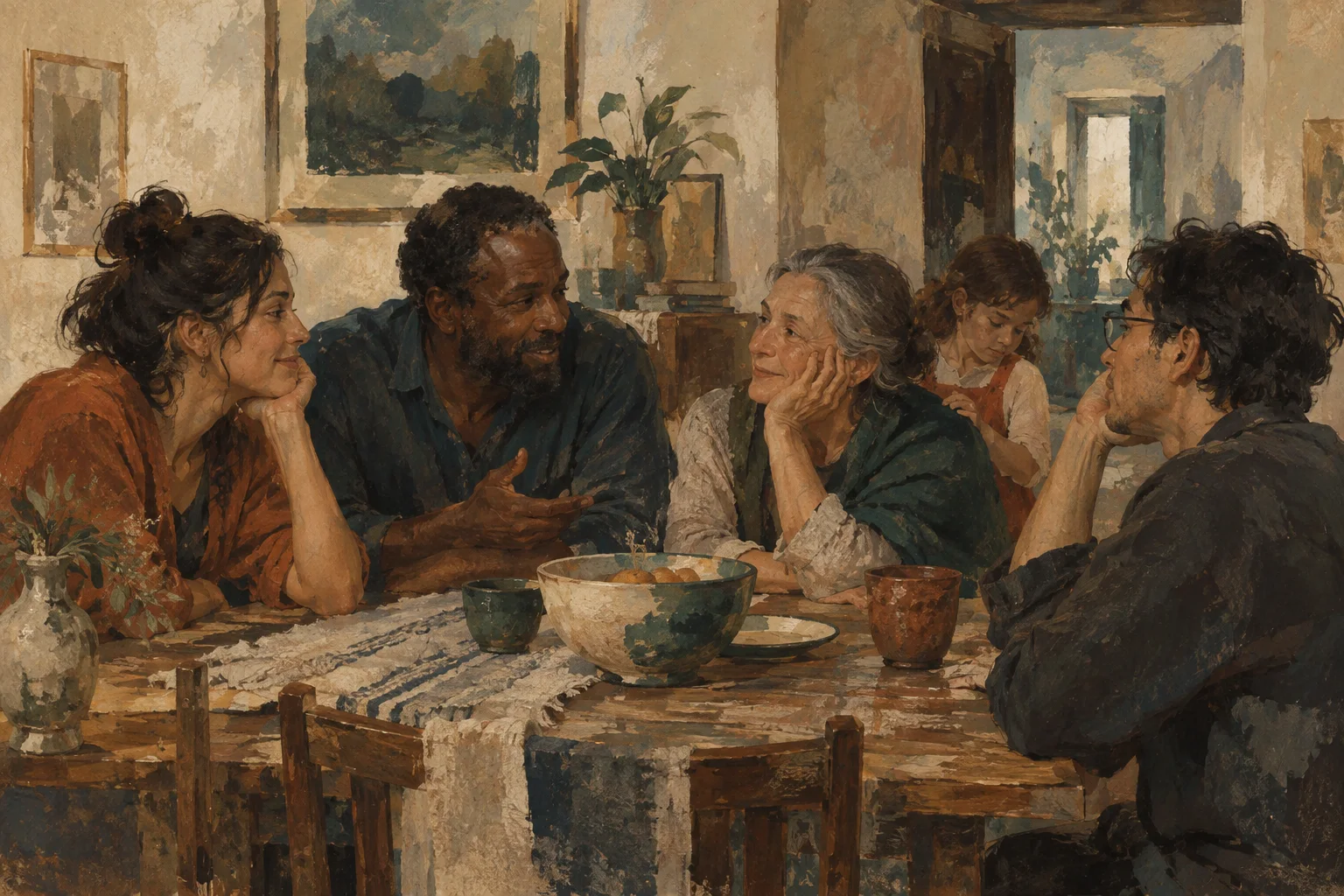
Participants arrive with families, partners, children, work, religious commitments, communities, and histories of belonging. Parenting, caregiving, veteran identity, professional identity, sexuality, gendered expectations, moral systems, and a sense of duty may all become prominent. An experience can clarify a role, loosen its hold, or leave someone unsure how to inhabit it. The consequences extend beyond an internal change in mood: other people may depend on the participant, disagree with a new interpretation, or be affected by decisions made afterward. (Bathje et al., 2022)
A powerful realization does not always require immediate enactment. Integration can include considering a major relationship decision over time, discussing it in an appropriate setting, and examining practical responsibilities. This is different from asking someone to tolerate danger. Where abuse or immediate safety is involved, timely support and protective action take priority. The aim is to help a person choose with adequate information and support, rather than make emotional intensity the only measure of urgency.
Cultural humility also requires examining the practitioner’s assumptions. Healthy autonomy, family obligation, sexuality, emotional disclosure, spirituality, and independence have meanings shaped by social worlds. A practitioner may celebrate separation where a participant values interdependence, or read religious belonging only as repression when it also provides care. Gearin and colleagues use Chinese palliative care to examine how psychedelic therapy’s cultural portability cannot be assumed. Their commentary supports sustained reflection on power and meaning; it is not a universal account of any culture. (Gearin et al., 2026)
Psychedelic settings may also borrow Indigenous, Eastern, ceremonial, or religious practices without understanding their histories or obligations. Cultural respect involves asking who has authority to teach a practice, whether permission is appropriate, how it is represented, and whether reciprocity accompanies its use. A participant’s moving experience does not by itself authorize them to speak for a tradition. Ethics discussions of respect and reciprocity provide a relevant professional context. (McGuire et al., 2024)
A relational field
Person
Identity, intimacy, values, and the participant’s own account.
Relationships
Family, partners, community, and experiences of belonging.
Setting
Cultural expectations, professional roles, and boundaries.
A reading aid drawn from this chapter’s practice discussion.
In Practice
A participant leaves a session convinced they must end a marriage immediately. The practitioner explores what has become clear, whether there is danger, and which facts remain unresolved. Where there is no urgent safety issue, a conversation with suitable support and time to consider consequences can help distinguish a durable decision from the first response to an intense experience.
Another participant confronts sexuality alongside religious shame. The practitioner creates room for both the person’s sexual identity and the meanings of religious belonging, avoiding pressure either to abandon faith or suppress sexuality. Appropriate referral may be useful if the practitioner cannot offer competent, affirming support within that complexity.
A participant wants to begin conducting a ceremony they encountered in a retreat. The practitioner asks what they know about its community of origin, how they were taught, and whether they have any recognized basis for teaching it. Interest can become a reason to learn and seek appropriate relationships, rather than claim authority after a single experience.
A person initially describes the loss of an old identity as liberating, then finds that work, parenting, and ordinary relationships feel unreal or impossible. The follow-up attends to sleep, distress, functioning, support, and the course of the change. Celebration of transformation should not obscure a growing need for clinical assessment or additional care.
Evidence Boundary
Social learning, identity, relationships, sexuality, cultural formulation, and family systems provide contemporary ways to examine this material. The cited integration and cultural humility literature supports attention to context and consequences, with different kinds of evidence and unresolved questions. It does not establish Leary’s developmental stages or make his gendered and evolutionary assumptions a professional standard. (Gearin et al., 2026) (Bathje et al., 2022)