

Search competencies and applied modules
Ibogaine safety and risk management
During Treatment
Monitoring, physical support, communication, and the acute experience.
Educational material; not a treatment relationship.
3 Administration and Acute Monitoring
Facilitation and experiential assessment
Coordinate relational support, consent, sensory conditions, and assessment of changes in attention and behavior.

Image context
Illustrative editorial image: low-stimulation support during movement-sensitive nausea. Not a clinical case photograph.
Supporting the Participant Through the Acute Experience
Bedside care by phase, communication, consent, movement, distress, and practical support workflow.
Supporting the Participant Through the Acute Experience
Bedside care by phase, communication, consent, movement, distress, and practical support workflow.
The acute phase is where medical observation and ordinary human care have to coexist without competing for the room. Experienced ibogaine providers repeatedly describe the same practical demands: the person may want very little conversation, may be extremely sensitive to light and sound, may become too ataxic to walk safely, may become nauseated when moved, and may need intimate help while remaining fully aware of what staff are doing. Contemporary clinical-trial guidance reaches many of the same conclusions: keep the setting calm, reduce unnecessary personnel and stimulation, use clear simple communication, avoid sudden movements, and obtain consent before nonessential touch (Rocha et al., 2023).
- Responsibility
- Facilitator · Program / system
- Applies in
- Multiple settings
Recognizing distress before it escalates
Some participants may have difficulty naming what is making an experience harder. Notice changes from the person’s baseline and ask a short, concrete question before assigning an interpretation. A request to stop may concern sensory load, nausea, discomfort, fear, touch, trust, or an actual medical or interpersonal problem. Clarify the request while clinical observation continues.
| Possible observation | Clarify with the participant | Reversible support when clinically appropriate |
|---|---|---|
| Removing headphones, covering the ears, repeated eye opening, or fearful scanning | Is the music, sound, light, darkness, or eye covering making this harder? | Lower unnecessary sound; stop or change music if requested. Offer eye opening or removal of an eye covering. Adjust light toward the participant’s need for comfort and orientation. |
| Pulling away from touch, shortening responses, increasing mistrust, or asking for space or a particular person | Would less touch, more distance, fewer people, or another staff member help? | Stop nonessential touch or bodywork. Reduce staff traffic and side conversations. Let one calm, preferred or familiar person take the lead where possible. |
| Restlessness, repeated repositioning, or nausea that increases with movement | Are you uncomfortable, too hot or cold, bothered by a smell, or feeling worse when you move? | Slow movements and minimize unnecessary repositioning. Adjust temperature or strong scents where possible. Preserve assisted movement, clinical access, and monitoring. |
| Requests for clarification, silence, or statements that the room feels wrong | What feels wrong right now? Would you like an explanation, quiet, or someone nearby? | Explain alarms and procedures in plain language. Offer quiet presence and practical choices. Check the actual interaction and any reported boundary concern. |
| A sudden wish to stand or leave, increasing agitation, difficulty reorienting, or a change in breathing | What is driving the request, and has attention, orientation, breathing, or other physiology changed? | Keep the person physically supported and involve the clinical team for concerning changes. A quieter room must not delay assessment or the emergency response. |
These observations do not establish a diagnosis. Ask before changing the environment, try an appropriate reversible adjustment, and check its effect. Avoid mechanically applying every option. Record the participant’s words, observations, changes made, response, and unresolved concerns for the next person providing care.
When the participant remains medically and psychiatrically stable in a safe setting, explain that the acute drug state needs time to change. Help them remain calm and supported through that period. A request for relief does not by itself establish psychosis, resistance, treatment failure, or a need for deeper psychological processing. Reports of mistreatment, coercion, unwanted touch, recording, restraint, or another boundary violation require direct assessment.
Image context
Illustrative editorial image: low-stimulation support during movement-sensitive nausea. Not a clinical case photograph.
Real-World Support Workflow
| Support domain | Field practice that can be used now | Boundary |
|---|---|---|
| Room setup | Quiet, private room; comfortable bed; dimmable light; direct bathroom path; emesis supplies, towels, clean bedding/clothes, and needed items within reach; reduce unnecessary staff traffic. | Medical monitoring, alarm audibility, airway access, and emergency movement must remain possible. |
| Presence | Use a familiar lead attendant when possible. Stay available without filling silence. Community guidance and provider notes repeatedly describe participants preferring long periods of inward quiet. | A quiet participant is still monitored. Reduced conversation never means reduced medical observation. |
| Communication | Speak softly and concretely. Ask short questions. Explain what you are about to do before moving, touching, examining, or bringing additional staff into the room. Avoid arguing with visionary content or supplying interpretations during peak impairment. | New confusion, disorientation, paranoia, agitation, or inability to answer basic safety questions may require medical/psychiatric reassessment. |
| Movement | Do not make the participant sit, stand, turn, or walk simply for staff convenience. Cluster care, slow transitions, pause when vertigo or nausea rises, and use enough assistance for transfers. | Movement minimization never overrides a necessary examination, ECG, airway intervention, emergency transfer, or evaluation of a new neurological sign. |
| Bathroom and toileting | Plan before dosing. Keep the path clear, have assistance ready, consider bedside options when clinically and ethically appropriate, protect privacy, and avoid leaving an ataxic participant to walk alone. | Choice of toileting method must account for falls, infection/hygiene, participant preference, and clinical needs. |
| Emesis and nausea | Keep a basin/bag within reach before symptoms start. Use recumbent or otherwise safe positioning when appropriate, minimize motion triggers, track repeated losses, and reassess swallowing/airway before oral intake. | Blood in emesis, persistent vomiting, aspiration concern, hypoxia, significant dehydration, or electrolyte disturbance requires clinical management. |
| Sensory load | Dim light, reduce unnecessary noise, allow eye mask or ear protection if safe, use music only when desired, avoid strong scents, and keep environmental changes predictable. | Sensory tools should never prevent the participant from hearing necessary instructions or staff from monitoring them. |
| Touch | Discuss likely support before dosing. During the session, ask before non-emergency touch and stop when the participant wants it stopped. A steady hand can be grounding for some people and intrusive for others. | Emergency intervention follows medical necessity and local consent/capacity standards. |
| Documentation | One person can document while another remains relationally present. Avoid making the participant feel interviewed or studied during distress when information can safely be recorded immediately afterward. | Objective medical events, medications, rhythm changes, and time-sensitive observations still require contemporaneous documentation. |
| Shift handoff | Pass forward the actual state of the person: movement ability, nausea triggers, preferred communication, touch boundaries, hydration/intake, unresolved symptoms, ECG trajectory, medication changes, and what currently helps or agitates them. | A handoff is incomplete if the incoming staff member knows the numbers but not the person, or knows the person but not the unresolved medical risk. |
FIELD PRACTICE BASIS: Dickinson et al. (GITA, 2016), Lotsof & Wachtel historical manual, Wells provider notes, Rocha et al. (2023), and monitored human ibogaine studies. The practical recommendations above are retained where they are low risk, reversible, participant centered, and compatible with current medical care. Outdated community medication, dosing, electrolyte, or monitoring rules are not imported wholesale.
Bedside Support by Phase
The same supportive action can be appropriate at one point in the session and disruptive at another. Use the sequence below as an operational rhythm rather than a rigid clock. The participant’s physiology, level of impairment, preferences, and clinical trajectory determine when the team moves from one phase to the next.
Before peak impairment
- Facilitator focus
- Prepare the room before mobility and communication become difficult. Clear paths, place emesis supplies and hygiene items within reach, confirm toileting and touch preferences, organize monitor cables, reduce unnecessary traffic, identify the lead voice, and make sure the next shift knows the plan.
- Clinical boundary
- Preparation does not replace baseline assessment, monitoring, or an emergency plan. Any new instability before peak effect changes the clinical plan.
Peak impairment
- Facilitator focus
- Keep communication simple and predictable. Minimize unnecessary movement, assist transfers, protect privacy, keep emesis supplies accessible, reduce sensory load when desired, and stay present without filling silence. Preserve participant choice wherever safety allows.
- Clinical boundary
- Do not attribute new confusion, focal deficits, syncope, abnormal breathing, seizure, hemodynamic change, or dangerous behavior to the psychedelic process without medical assessment.
Transition and early recovery
- Facilitator focus
- Reintroduce movement gradually, reassess gait before independence, offer fluids and simple food according to swallowing safety and tolerance, continue documenting nausea and intake, protect opportunities for rest, and watch whether fear, mistrust, or activation is settling or escalating.
- Clinical boundary
- Persistent ataxia, repeated vomiting, unresolved ECG findings, worsening psychiatric activation, or inability to maintain basic safety requires continued monitoring or higher-level evaluation.
Post acute and handoff
- Facilitator focus
- Return autonomy in steps. Review what the participant needs for medication follow up, transportation, supervision, sleep, nutrition, addiction care, and psychological support. Hand off the person as well as the numbers: what helps, what agitates, what remains unresolved, and what the participant understands about the next plan.
- Clinical boundary
- The end of visions is not a discharge criterion. Disposition follows the medical, neurological, psychiatric, functional, and addiction-care trajectory.
FIELD PRACTICE NOTE: This sequence organizes existing clinical evidence and field-practice content into a usable bedside workflow. It is not a validated timing protocol and should not be used to override patient-specific clinical judgment.
Expert practice · Project synthesis / non peer reviewed · Practice confidence: Expert Operational Practice
Dickinson (2016); Lotsof (2003); Wells · 3 more
View Evidence 7 sources
Continue Through the Global Competencies
Sensory and Relational Containment
Adjust stimulation and staff traffic while preserving monitoring, access, and participant preferences.
Sensory and Relational Containment
Adjust stimulation and staff traffic while preserving monitoring, access, and participant preferences.
Keep the room predictable and low traffic. Introduce unfamiliar people, avoid side conversations around the bed, control unnecessary light and noise, and ask about music, eye covering, touch, and scent rather than assuming preference. Sensory containment should make the room easier to tolerate without blocking alarm audibility, observation, communication, or emergency access.
- Responsibility
- Facilitator · Program / system
- Applies in
- Multiple settings
Early signs of distress and reversible support
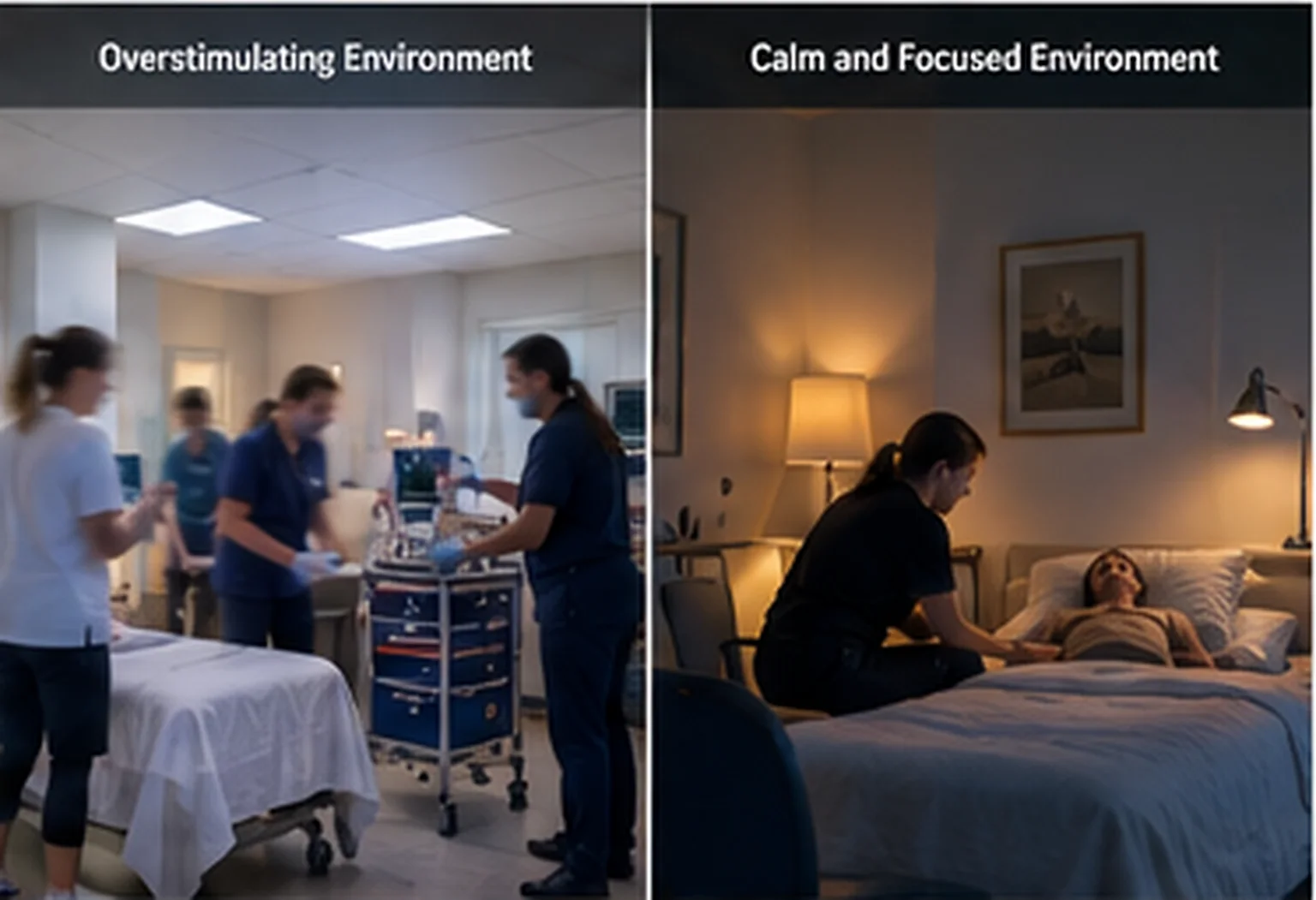
Image context
Illustrative editorial comparison: overstimulating and calm treatment environments. Not clinical case photographs.
Small details can change the room. Multiple staff members whispering near the bed, bright overhead light, a television, phones, an unfamiliar person entering without introduction, sudden repositioning, strong incense, or repeatedly asking the participant to describe what they are seeing can become disproportionately intrusive. A quieter setup is often better: one lead voice, predictable introductions, low traffic, a room that can be darkened without compromising observation, and enough restraint from the team to let the participant have an internal experience without performing it for staff.
When the participant becomes suspicious of caregivers or interprets ordinary actions as hostile, reduce the number of voices, avoid crowding, explain medical actions plainly, keep movements slow, and do not argue about the literal truth of the perception. Preserve ordinary choice wherever possible. If the change is accompanied by worsening orientation, dangerous behavior, severe agitation, sleep-deprived activation, hypoxia, abnormal vital signs, or another medical concern, the clinical differential takes priority over the psychedelic narrative.
Field Practice and Clinical Practice Can Coexist
A real-world tool should not force practitioners to choose between “evidence based” and “experienced based” care when the source types are answering different questions. Cardiology should determine how an unstable rhythm is handled. Toxicology should guide a dangerous interaction. Addiction medicine should guide withdrawal and ongoing treatment. Experienced ibogaine practice can still teach the team to put the emesis basin within reach before the person becomes unable to sit up, to plan bathroom assistance before ataxia peaks, to avoid unnecessary conversation during deep inward absorption, to arrange shifts before anyone is exhausted, and to understand that a person can be physically helpless while mentally aware. Those are different kinds of knowledge, and the resource should preserve both.
In practice
Ask before making a series of environmental changes. Offer one reversible adjustment at a time and observe how the person responds. Record preferences for the next shift, including when quiet company is more welcome than reassurance. Maintain necessary monitoring and access while reducing avoidable intrusion.
Expert practice · Project synthesis / non peer reviewed · Practice confidence: Expert Operational Practice
Dickinson (2016); Lotsof (2003); Wells · 1 more
View Evidence 5 sources
Continue Through the Global Competencies
Phenomenology and Experiential Safety
Explore reported experiences alongside orientation, attention, behavior, physiology, and escalation concerns.
Phenomenology and Experiential Safety
Explore reported experiences alongside orientation, attention, behavior, physiology, and escalation concerns.
Ibogaine can look quiet from the outside while the person is having an enormous internal experience. Some people have little or no imagery. Others move through vivid autobiographical scenes, symbolic material, frightening images, spiritual experiences, or periods that are hard to describe at all. The team needs enough familiarity with that range to protect the body, stay relationally grounded, and recognize when the experience is drifting into delirium, mania, psychosis, or unsafe behavior.
Facilitator Support Principles
The facilitator’s job is to make the experience physically and relationally safer without taking over its meaning. That includes knowing when not to move the participant, when to reduce stimulation, how to explain care before touching, how to preserve privacy during vomiting or toileting, and how to recognize when a difficult experience is becoming a medical or psychiatric problem. The person can be profoundly impaired in coordination and still remain aware of how they are being treated.
- Keep the room predictable
Use one calm lead voice, minimize unnecessary staff traffic, explain alarms and procedures when useful, and avoid crowding.
- Preserve choice where safe
Offer options about light, music, silence, eye covering, touch, positioning and who is present. Medical necessity can override preference only when the clinical situation requires it.
- Move only with a reason
Severe ataxia and movement sensitive nausea make unnecessary standing, walking, head turning, or repeated repositioning burdensome. Cluster necessary care and move slowly.
- Protect dignity during dependency
Plan toileting, emesis, clothing, hygiene, transfers, and physical assistance before the participant loses coordination.
- Do not force processing
Peak intoxication is not the time to push disclosure, trauma interpretation, confession, or life decisions. Support what emerges and save deeper interpretation for a more stable state.
- Watch physiology and relationship together
Fear, mistrust, dizziness, nausea, or silence may be experiential, medical, or both. Observe trajectory, function and objective findings.
- Know your role boundary
A facilitator recognizes change and escalates. A licensed clinician assesses and treats within scope. Ceremonial authority does not replace medical authority in an emergency.
What the Experience Can Feel Like
Published phenomenology is much broader than the stereotyped “visionary journey.” Heink et al. found altered perception, autobiographical insight, and wide variation in visual experience. Brown, Noller, and Denenberg described oneiric material involving repeating imagery, remorse, guilt, relationships, release, and spiritual themes. Kohek et al. identified physical, sensory, visual, cognitive, auditory, adverse, anti dependency, and after effect categories, including ancestors or entities, landscapes, and horrific scenarios. The 2025 Ibogaine Experience Scale, developed in 499 participants, captured seven dimensions spanning symbolic visions, visual change, discomfort and challenge, archetypal or cosmic content, introspection, somatosensory activation, and dissociation.
Experiences and clinical distinctions
| Experiential domain | What a participant may report | Clinical meaning for the team |
|---|---|---|
| Little or no visionary content | Minimal imagery, darkness, ordinary thoughts, or a largely bodily experience. | Do not increase pressure, suggest content, or imply the treatment is failing. Continue ordinary monitoring and support. |
| Visual and narrative material | Rapid sequences, scenes, people, animals, landscapes, childhood memories, symbolic stories, or imagery that feels film like or dream like. | Ask simple descriptive questions only when useful. Avoid directing the story or treating symbolic content as factual memory. |
| Dark or frightening material | Death, violence, isolation, guilt, fear, threatening entities, horrific scenes, or a sense of being trapped. | Reduce stimulation, orient when needed, assess safety and attention, and support without forcing interpretation. Dark content alone is not delirium or psychosis. |
| Auditory and sensory change | Buzzing, drumming like sounds, auditory hypersensitivity, altered body perception, changes in light, sound, time, space, touch, or synesthetic effects. | Check that unusual sensory reports are not being caused by equipment, hypoxia, focal neurological change, or another medical problem. Otherwise treat them as possible drug effects. |
| Autobiographical review | Past relationships, childhood, regret, grief, remorse, guilt, alternative life trajectories, or a detached observer quality. | Maintain confidentiality, do not conduct an aggressive psychotherapy session during peak impairment, and reserve deeper meaning making for a more stable post acute period. |
| Dissociation or altered self experience | Detachment from body or identity, ego dissolution, unusual sense of self, death or rebirth themes. | Assess orientation, attention, capacity, and behavior. A participant can have unusual self experience while remaining medically stable and behaviorally safe. |
| Relational threat or mistrust | The participant may suddenly feel watched, controlled, betrayed, unsafe, or convinced that caregivers are acting against them. | Use the Transient persecutory mistrust framework below. The team should lower interpersonal pressure while actively ruling out delirium, emerging psychosis, mania, intoxication, withdrawal, or medical instability. |
In practice
Receive the person’s account without trying to settle its meaning during the session. Acknowledge distress and ask what kind of support is welcome. Keep observation of orientation, behavior, and physical condition active alongside listening, and involve the clinician when a change exceeds ordinary supportive care.
Participant phenomenology · Project synthesis / non peer reviewed
Heink (2017); Kohek (2020); Brown (2019) · 6 more
View Evidence 10 sources
Continue Through the Global Competencies
Transient Persecutory Mistrust: When the Room Feels Like the Enemy
Relational response and a differential spanning delirium, mania, psychosis, withdrawal, and medical change.
Transient Persecutory Mistrust: When the Room Feels Like the Enemy
Relational response and a differential spanning delirium, mania, psychosis, withdrawal, and medical change.
Treat transient caregiver-centered mistrust as a relational safety problem while maintaining the medical and psychiatric differential. Reduce crowding and side conversations, use one calm lead voice, explain actions before taking them, preserve choices where safe, and avoid arguing about the literal truth of the perception. Escalate when mistrust becomes fixed or increasingly disorganized, necessary care cannot be delivered safely, threats emerge, or physiology and orientation change.
- Responsibility
- Facilitator · Clinical team
- Applies in
- Multiple settings
The closest established clinical language is acute paranoid or persecutory ideation, but the caregiver centered presentation described in ibogaine practice does not appear to have a standardized diagnostic name. This lens therefore uses Transient Persecutory Mistrust as descriptive project language for a temporary state in which ordinary monitoring, staff conversations, touch, redirection, or necessary medical care are interpreted as deceptive, controlling, or threatening. It is not a diagnosis and does not establish psychosis by itself. Broader psychedelic literature describes paranoid psychotic reactions in a subset of acutely distressing experiences and recognizes perceived threat as part of some traumatic psychedelic experiences (Bröcker et al., 2026; Calder et al., 2026).
When this develops, reduce avoidable staff traffic and side conversations, use one calm lead voice, explain actions before taking them, preserve choices where safety allows, and avoid arguing about the content of the belief. The facilitator should stay curious about what the participant is perceiving while the clinical team continues to assess oxygenation, rhythm, withdrawal, delirium, medication effects, sleep loss, mania, psychosis, and other causes of an abrupt change in interpretation. The trajectory matters. Brief mistrust that softens as stimulation drops is different from increasingly fixed persecutory beliefs, disorganization, grandiosity, threats, or loss of behavioral control.
| Question | More consistent with a containable altered state | Raises concern for delirium, mania, psychosis, or dangerous escalation |
|---|---|---|
| Attention and orientation | Can answer simple orientation questions or reorient with calm prompting; attention is largely sustained. | Marked inattention, fluctuating consciousness, progressive disorientation, inability to follow simple safety instructions. |
| Relational stance | Mistrust rises and falls; person can accept distance, a different staff member, or simple reassurance. | Fixed or escalating persecutory conviction, inability to tolerate any caregiver, threatening behavior, attempts to flee despite physical risk. |
| Thought and speech | Unusual or symbolic content remains understandable in context. | Increasingly disorganized speech, pressured speech, grandiosity, severe thought disorder, or bizarre beliefs that persist outside the expected acute state. |
| Physiology | Vital signs, oxygenation, neurological examination, and rhythm remain consistent with the known trajectory. | Hypoxia, seizure, fever, focal findings, worsening consciousness, arrhythmia, hypotension, severe withdrawal, or other medical instability. |
| Time course and sleep | Threat perception softens as the acute state resolves and the person can rest. | Symptoms persist or intensify after expected drug effects, especially with prolonged inability or reduced need to sleep, manic activation, or functional deterioration. |
Relational response: simplify the room. One calm person speaks. Give the participant physical space, explain what you are doing before you do it, and offer choices whenever safety allows. If another staff member feels safer to the participant, let that person take the lead. Avoid crowding, arguing, matching hostility, or turning the team into an audience. Keep assessing for delirium, seizure, hypoxia, arrhythmia, withdrawal, and emerging psychiatric danger at the same time.
In practice
Explain who you are, what you are doing, and what choices remain. Reduce unnecessary voices and offer contact with a familiar or alternate staff member when feasible. Check whether an actual boundary violation, misunderstanding, sensory problem, or clinical change is contributing before assigning the experience to altered-state mistrust.
Participant phenomenology · Project synthesis / non peer reviewed
Bröcker (2026); Calder (2026); Marta (2015) · 1 more
View Evidence 5 sources
Continue Through the Global Competencies
Visionary Intensity, Orientation, and Grounding
Eye opening and orientation, participant choice, and the provenance of reported grounding practices.
Visionary Intensity, Orientation, and Grounding
Eye opening and orientation, participant choice, and the provenance of reported grounding practices.
Use reversible grounding choices before forceful interpretation. One calm voice, eye opening, orientation to place and time, carefully adjusted light or sound, and previously consented grounding contact may reduce immersion when the participant is medically and psychiatrically stable. Continue assessing for delirium, seizure, hypoxia, dangerous agitation, mania, psychosis, or other objective change when the presentation no longer fits ordinary psychedelic distress.
- Responsibility
- Facilitator · Clinical team
- Applies in
- Multiple settings
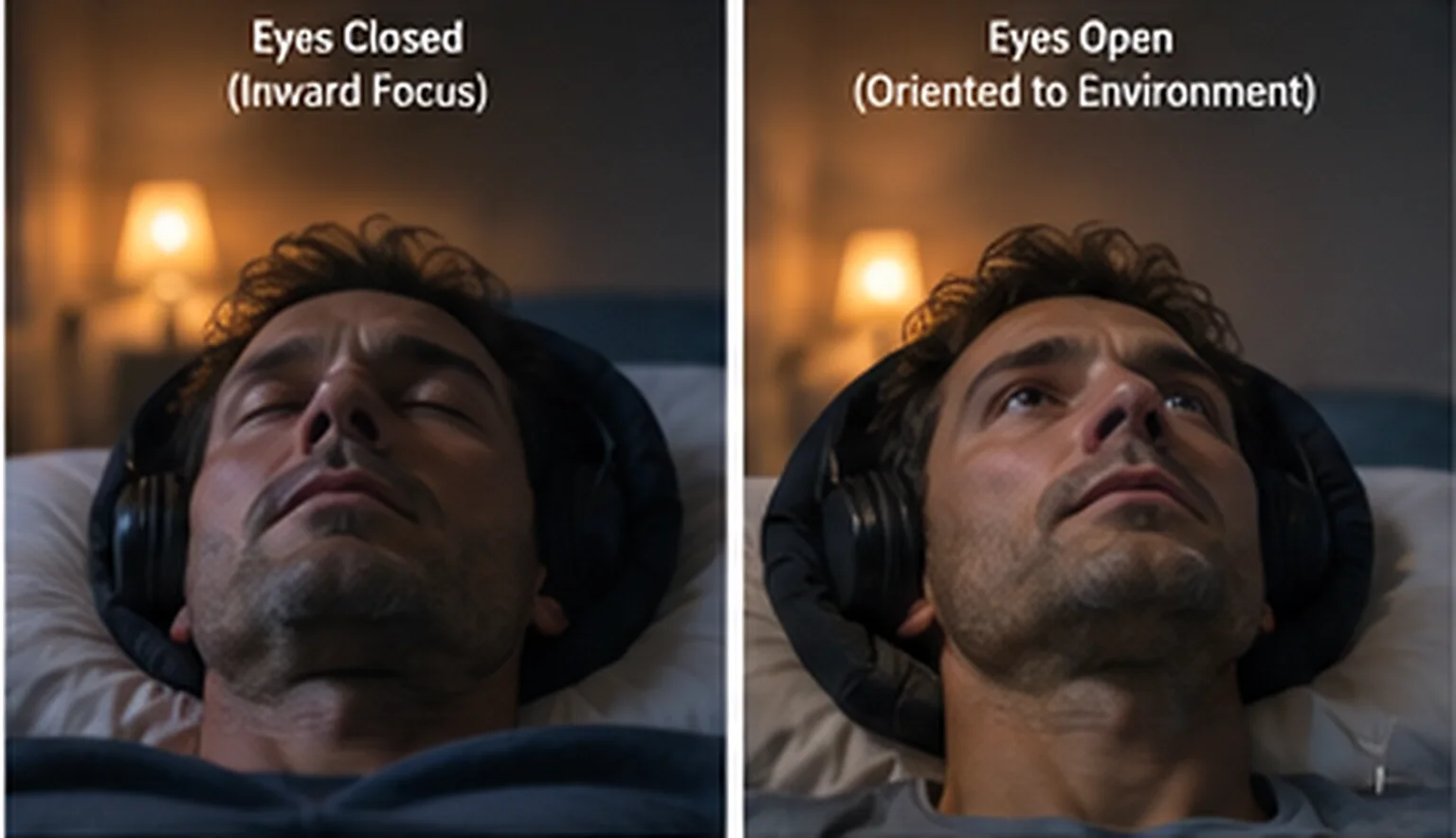
Image context
Illustrative editorial comparison: eyes closed and eyes open as different experiential states. Opening the eyes may be offered as a reversible grounding option.
Intense visionary material does not automatically require interpretation, confrontation, or deeper immersion. Ibogaine's visual phenomena are often strongest with the eyes closed, and a peer-reviewed description of the ibogaine medical subculture notes that these internally represented visual phenomena tend to be suppressed when the eyes are opened (Alper et al., 2008). Historical provider guidance describes the same practical observation. Hattie Wells also described the effect in a 2022 public interview, and the Sacred Warrior Community participant workbook separately teaches opening the eyes as an optional break from closed-eye visuals and a way to reorient to the body. This gives facilitators a simple, low-complexity orientation option when the participant wants less immersion: invite the person to open the eyes, orient to the room, reduce sensory isolation, and re-establish ordinary contact without insisting that they remain inside overwhelming imagery.
A participant asking for the experience to become less intense should not be told that distress must be endured because the medicine is supposedly forcing necessary material. First determine whether the problem is primarily visionary intensity, sensory overload, relational fear, panic, delirium, mania, psychosis, hypoxia, syncope, arrhythmia, withdrawal, or another medical change. When the person remains medically and psychiatrically stable, supportive grounding may include one calm voice, opening the eyes, gentle orientation to place and time, reducing unnecessary noise or darkness, changing the sensory environment, and offering previously consented grounding contact if the participant wants it. None of these measures should be represented as guaranteed to terminate the oneirogenic state.
Word of mouth from indigenous iboga practice describes offering banana when visions become too intense, with the intention of reducing the visions. If offered, explain its purpose and respect the participant’s choice. Check that the person is alert enough to swallow safely and that eating fits the care plan.
Related contemporary accounts describe a similar purpose. In an interview with Nick Urban, Jeff McNairy describes bananas being used to help people come down from the intensity of iboga (38:51). An online community account by Entheobirth describes retreats offering bananas after a session to temper lingering effects. These are practitioner and community accounts.
Eye opening as a way of reducing closed eye visual phenomena is described by Alper et al. (2008), historical provider guidance, Hattie Wells’ 2022 practitioner interview, and separately a Sacred Warrior Community participant workbook. Offer it according to the participant’s preference and response.
In practice
Ask whether the participant wants help shifting attention or simply a calm presence nearby. Offer choices without insisting on an interpretation or a preferred emotional outcome. Reassess the response and continue clinical observation; grounding is a supportive option rather than a reason to defer assessment of a concerning change.
Participant phenomenology · Project synthesis / non peer reviewed · Evidence gap
Alper (2008); Wells; Wells (2022) · 5 more
View Evidence 9 sources
Continue Through the Global Competencies
Touch, privacy and toileting
Prearranged assistance, ongoing consent, minimum exposure, privacy, and emergency exceptions.
Touch, privacy and toileting
Prearranged assistance, ongoing consent, minimum exposure, privacy, and emergency exceptions.
Discuss likely touch and toileting needs before dosing. Ask before nonemergency touch, use only the exposure needed for safe care, explain intimate care before it occurs, and honor previously stated preferences when possible. Do not mistake physical dependence for impaired awareness. Emergency intervention follows capacity, safety, and local clinical standards, but dignity remains part of the response.
- Responsibility
- Program / system · Facilitator
- Applies in
- Multiple settings
In practice
Anticipate intimate care before impairment develops, including preferred assistance and privacy measures. During care, describe each step and seek agreement for nonemergency touch. Preserve as much agency as possible when the person is physically dependent, and carry those preferences across staff handoffs.
Expert practice · Project synthesis / non peer reviewed · Practice confidence: Expert Operational Practice
Ibogaine Patient’s Bill of Rights. Reproduced in Clinical Guidelines for Ibogaine-Assisted Detoxification (GITA; Dickinson (2016); Karpetas (2010)
View Evidence 4 sources
Participant Rights, Advocacy, Complaints, and Grievance
Continue Through the Global Competencies
Mobility, nausea, and supportive care
Anticipate physical dependency, distinguish dizziness syndromes, and protect airway, privacy, and basic function.

Image context
Illustrative editorial image: assisted mobility during ibogaine related ataxia. Not a clinical transfer demonstration.
Ataxia, Vertigo, Movement Sensitivity, Nausea, and Physical Vulnerability
Assisted transfers, motion provoked nausea, falls, toileting, and neurological reassessment.
Ataxia, Vertigo, Movement Sensitivity, Nausea, and Physical Vulnerability
Assisted transfers, motion provoked nausea, falls, toileting, and neurological reassessment.
Assume that marked mobility impairment may develop. Prepare the path, toileting plan, staffing, and supplies before peak impairment. Keep needed objects within reach, assist transfers according to actual function, and do not use unsupported walking as a test of cooperation or recovery. Escalate new focal weakness, asymmetric findings, syncope, seizure, worsening consciousness, severe headache, unusual nystagmus, or an unexpected neurological course.
- Responsibility
- Facilitator · Clinical team
- Applies in
- Medically supervised administration · Research setting
Image context
Illustrative editorial image: assisted mobility during ibogaine related ataxia. Not a clinical transfer demonstration.
Severe ataxia is not a side note to the experience. In the Knuijver cohort, every participant developed clinically evident cerebellar ataxia and could not walk unsupported at peak effect. Luciano’s peer reviewed clinical observation described transient vestibulocerebellar dysfunction with nystagmus, intention tremor, gait ataxia, and prominent movement induced nausea and vomiting. These data fit the practical observation that a person can feel relatively settled while lying still and become abruptly nauseated or vertiginous when asked to sit, stand, turn the head, or walk (Knuijver et al., 2022; Luciano, 1998).
General vestibular physiology provides a plausible explanation. Vestibular and gastrointestinal emetic signals converge in brainstem and cerebellar networks involved in motion sickness and vomiting (Yates et al., 2014). That does not prove that all ibogaine nausea is vestibular. Drug effect, withdrawal, gastrointestinal illness, anxiety, coexposures, dehydration, and other causes remain possible. It does support treating movement as a modifiable symptom trigger when the participant is otherwise medically stable.
Practical support is simple: do not make the person move merely because it is convenient for staff. Keep necessary objects within reach. Cluster examinations and care when possible. Explain a position change before it happens, move slowly, pause when nausea or vertigo rises, and use enough assistance that the participant is not balancing independently. If the participant needs the bathroom, plan the route and the number of people required before standing. When the clinical question can be answered safely in bed, do not turn ambulation into a test of cooperation.
Movement minimization is supportive care, not a reason to skip a necessary neurological examination, delay an ECG, or ignore a new focal finding. Persistent or asymmetric vertigo, focal neurological deficits, worsening consciousness, unusual nystagmus, severe headache, recurrent syncope, or a course that does not fit expected recovery deserves medical evaluation.
- Before peak impairment
Clear walking paths, preposition emesis supplies, plan toileting, explain likely loss of coordination, identify who assists movement, and make privacy arrangements.
- When resting
Allow a stable recumbent or otherwise comfortable position when medically appropriate. Reduce unnecessary visual and physical motion if it worsens nausea.
- When sitting or standing is necessary
Use a slow planned transition with direct assistance. Pause at each stage if vertigo or nausea increases. Reassess blood pressure or neurological status when clinically indicated.
- Toileting
Prefer the safest option the setting can provide. The participant should not walk unsupported simply because they are awake and conversational.
- During vomiting
Protect airway, assist positioning, reduce unnecessary movement, monitor consciousness, respiratory findings, fluid loss and electrolyte risk.
- When symptoms exceed the expected course
Evaluate medical and neurological causes rather than attributing persistent vertigo, weakness, altered consciousness or focal findings to ibogaine automatically.
- Transition out of peak impairment
Reassess gait before independent movement, reintroduce fluids and simple food according to tolerance and swallowing safety, review urination and bowel needs, reduce sensory protection gradually, and check whether the participant can understand and participate in care.
- Post acute recovery
Track residual dizziness, ataxia, nausea, sleep, activation, hydration, medication questions, withdrawal, mood, beliefs, and functional capacity. Complete a closed loop handoff or discharge plan rather than using the end of visions as the end of care.
The body can become profoundly dependent even while awareness is intact. In Knuijver’s safety cohort, all 14 participants developed measurable cerebellar ataxia, most strongly two to six hours after administration. Several still had residual signs at 24 hours, and nursing assistance was needed for bathroom trips. Vomiting also occurred and is reported across the broader literature. From the participant’s side, that can feel strange and vulnerable: the mind may be clear enough to know what is happening while the legs, balance, and coordination no longer feel reliable.
| Problem | Participant experience | Safety response |
|---|---|---|
| Ataxia | The person may feel detached from normal motor control, unable to stand straight, or surprised that the body will not do what is intended. | No unsupported ambulation while significant ataxia is present. Use planned assistance for transfers and toileting, keep paths clear, document motor trajectory, and reassess atypical or prolonged deficits. |
| Vomiting | Nausea can interrupt inward experience abruptly and may become frightening when balance and body control are poor. | Keep emesis supplies and suction capability accessible, assist positioning, monitor fluid loss and airway protection, and escalate repeated vomiting with declining consciousness, respiratory change, hemodynamic instability, or inability to maintain hydration. |
| Sensory hypersensitivity | Ordinary light, voices, touch, alarms, or movement may feel unusually intense. | Reduce nonessential stimulation while preserving required monitoring. Explain touch before contact when time allows and avoid unnecessary personnel changes. |
| Weakness and prolonged immobility | The participant may remain still for long periods because movement is difficult or because inward attention is intense. | Continue skin, circulation, toileting, hydration, and mobility assessment appropriate to the duration and clinical condition. Do not assume stillness means sleep or stability. |
| Dignity during dependency | The participant may require help with emesis, toileting, clothing, hygiene, or repositioning while deeply vulnerable. | Plan privacy, staffing, and consent before dosing. Use the minimum necessary exposure and explain care rather than treating loss of independence as routine or embarrassing. |
In practice
Explain the movement plan before touching or repositioning the person. Ask what they are trying to accomplish, arrange adequate assistance, and allow pauses. Preserve dignity in intimate tasks and document what level of assistance is actually needed so the next attendant does not overestimate independence.
Established clinical risk · Project synthesis / non peer reviewed
Knuijver (2022); Knuijver (2024); Luciano (1998) · 1 more
View Evidence 5 sources
Continue Through the Global Competencies
Distinguishing Vertigo, Ataxia, Disequilibrium, and Presyncope
Differentiate vertigo, ataxia, disequilibrium, and presyncope using description, triggers, and physiology.
Distinguishing Vertigo, Ataxia, Disequilibrium, and Presyncope
Differentiate vertigo, ataxia, disequilibrium, and presyncope using description, triggers, and physiology.
Ask the participant to describe the sensation rather than accepting “dizzy” as a complete assessment. Note whether symptoms are spinning, imbalance, presyncope, or motion triggered. Use slow assisted transitions when appropriate, but keep orthostasis, bradycardia, hypotension, dehydration, medication effects, and neurological causes in the differential. Atypical or worsening symptoms require clinical reassessment.
- Responsibility
- Facilitator · Clinical team
- Applies in
- Medically supervised administration · Research setting
Participants may use “dizzy” for several different experiences. The distinction matters because the practical response and the differential are not identical. Ask what the sensation actually feels like before assuming it is the expected ibogaine vestibulocerebellar effect.
| Experience | Typical description | Facilitator response | Clinical concern increases when |
|---|---|---|---|
| Vertigo / motion sensitivity | Spinning, moving, tilting, or nausea provoked by head/body movement | Reduce unnecessary movement, use slow transitions, pause, support recumbent rest when appropriate, keep emesis supplies close | New focal deficits, unusual or persistent nystagmus, severe headache, prolonged course, or other central signs. |
| Ataxia | Legs or limbs will not coordinate reliably; standing and gait are unsafe | Direct assistance, fall prevention, bathroom plan, do not ask the participant to prove they can walk | Asymmetry, focal weakness, worsening consciousness, injury, seizure, or failure to improve along the expected course. |
| Disequilibrium | Unsteady, floating, off-balance without clear spinning | Assisted transfers, minimize unnecessary standing, orient to stable surfaces | New neurological findings, severe worsening, or inability to support mobility safely. |
| Presyncope / orthostatic intolerance | Lightheaded, dim vision, weak, about to faint, especially on sitting or standing | Return to safe position, call clinical staff, check hemodynamic/rhythm context rather than assuming vertigo | Syncope, hypotension, bradycardia, arrhythmia, chest symptoms, ongoing symptoms, or injury. |
PRACTICE NOTE: Movement-provoked nausea is documented in human ibogaine observation, and vestibular physiology provides a plausible mechanism. It should be treated as one common pattern, not the only explanation for nausea, dizziness, or vomiting.
In practice
Give the person simple alternatives when the word “dizzy” is all they can find: spinning, imbalance, lightheadedness, or feeling about to faint. Let them describe the sensation without leading the answer. Communicate onset, triggers, associated findings, and change over time to the clinical team.
Established clinical risk · Project synthesis / non peer reviewed
View Evidence 4 sources
Continue Through the Global Competencies
Prolonged Supportive Care: Comfort, Toileting, Nutrition, and Rest
Coordinate oral intake, hygiene, toileting, temperature, positioning, rest, and participant led meaning work.
Prolonged Supportive Care: Comfort, Toileting, Nutrition, and Rest
Coordinate oral intake, hygiene, toileting, temperature, positioning, rest, and participant led meaning work.
Offer food and fluids according to alertness, swallowing, nausea, and the clinical plan. Ask what the participant wants and record what they tolerate. Word of mouth from indigenous iboga practice describes offering banana to reduce excessive visions. Explain this purpose when discussing the practice, respect the participant’s choice, and ask how they are experiencing the session.
- Responsibility
- Facilitator · Program / system
- Applies in
- Multiple settings
Long sessions create ordinary care needs that become easy to underestimate when attention is focused on the visionary process. A participant may remain in one position for hours, become sore, need help urinating, feel cold or overheated, have dry mouth, struggle to eat, or be unable to sleep despite exhaustion. None of those problems is glamorous, but they shape the safety and memory of the experience.
Plan rather than improvise. Keep bedding and clothing easy to adjust. Reassess comfort and positioning without creating unnecessary motion. Offer toileting support that preserves privacy. Track intake, urine, vomiting, and hydration when clinically relevant. Once nausea is settling and swallowing is safe, reintroduce fluids and simple food based on tolerance and the participant’s medical needs rather than forcing a large meal.
Word of mouth from indigenous iboga practice describes offering banana when visions become too intense, with the intention of reducing the visions. During recovery, food choices can follow appetite, tolerance, and preference. Clinical treatment of dehydration or an electrolyte deficit should follow the medical assessment.
Sleep needs explicit attention during recovery. Ibogaine can be followed by prolonged wakefulness, and sleep loss can blur the line between normal post acute activation and emerging psychiatric instability. Track sleep as a vital part of the psychiatric trajectory, not merely an inconvenience.
- Position and comfort
Reassess soreness, pressure, temperature, bedding and the need for slow position changes. Do not force frequent movement when the participant is comfortable and medically stable.
- Toileting and urination
Plan for severe ataxia. Use the safest privacy preserving option available within the setting and monitor unexpected inability to void or other urinary symptoms clinically.
- Oral fluids
Offer only when alertness and airway protection are adequate. Match fluid choice and amount to hydration, electrolytes, renal and cardiac status.
- Food
Reintroduce light, tolerable food when nausea is improving. Do not claim that a particular food corrects a laboratory abnormality.
- Skin and prolonged immobility
In long or medically complex sessions, use ordinary nursing judgment about pressure, circulation, skin integrity and repositioning needs while balancing movement sensitivity.
- Sleep and recovery
Record actual sleep, reduced need for sleep, agitation, and activation. Persistent inability to sleep with grandiosity, disorganization, paranoia or escalating energy changes the psychiatric assessment.
- Staff handoff
Every shift change should include rhythm trajectory, mobility, vomiting, intake, urine, sleep, mental status, trust/relational changes, medications and unresolved concerns.
Meaning Making Without Taking It Over
People may describe deceased relatives, entities, moral judgment, spiritual instruction, ancestral material, cosmic scenes, or an experience of death and rebirth. Stay curious and let the participant own the meaning. Questions such as “What was that like for you?” “What did it mean to you?” and “Do you want to stay with it, or would more orientation help right now?” leave room for the experience without turning the clinician’s belief system into part of the treatment.
EVIDENCE NOTE: phenomenology studies describe reported subjective experience. The 2025 IES is a validated measure of subjective effects; its factors are measurement domains rather than diagnostic categories or a template for what every person should experience.
In practice
Small care tasks accumulate over a long session. Check whether the person needs dry bedding, a different position, toileting assistance, quiet, or oral intake when appropriate. Coordinate tasks to reduce avoidable disturbance while responding promptly to discomfort and keeping monitoring continuous.
Expert practice · Project synthesis / non peer reviewed · Evidence gap · Practice confidence: Expert Operational Practice
Dickinson (2016); Lotsof (2003); Wells · 4 more
View Evidence 8 sources
Continue Through the Global Competencies
Nausea and vomiting
Motion sensitivity, emesis preparation, airway risk, fluid losses, and medication interaction review.
Nausea and vomiting
Motion sensitivity, emesis preparation, airway risk, fluid losses, and medication interaction review.
Place emesis supplies within reach before symptoms peak. When the participant is medically stable and movement clearly worsens symptoms, reduce unnecessary motion, explain position changes before they happen, and pause when symptoms rise. Position for airway safety, track repeated losses, and recognize when nausea has become a hydration, aspiration, electrolyte, medication, withdrawal, or other medical problem.
- Responsibility
- Facilitator · Clinical team
- Applies in
- Medically supervised administration · Research setting
In practice
Know the prescribed antiemetic, route, repeat limit, and reassessment plan before treatment. Report the frequency of vomiting, ability to keep fluids down, position related triggers, and any change in alertness. Persistent symptoms need clinician review of hydration, electrolytes, the ECG, and medication effects; the medication reference compares the available classes.
Established clinical risk · Project synthesis / non peer reviewed
Knuijver (2022); Knuijver (2024); Luciano (1998) · 2 more
View Evidence 6 sources
Ataxia, Vertigo, Movement Sensitivity, Nausea, and Physical Vulnerability
Supportive and Emergency Medications
Continue Through the Global Competencies
Monitoring and clinical capability
Assign roles, establish the baseline, follow physiological trends, and rehearse escalation.
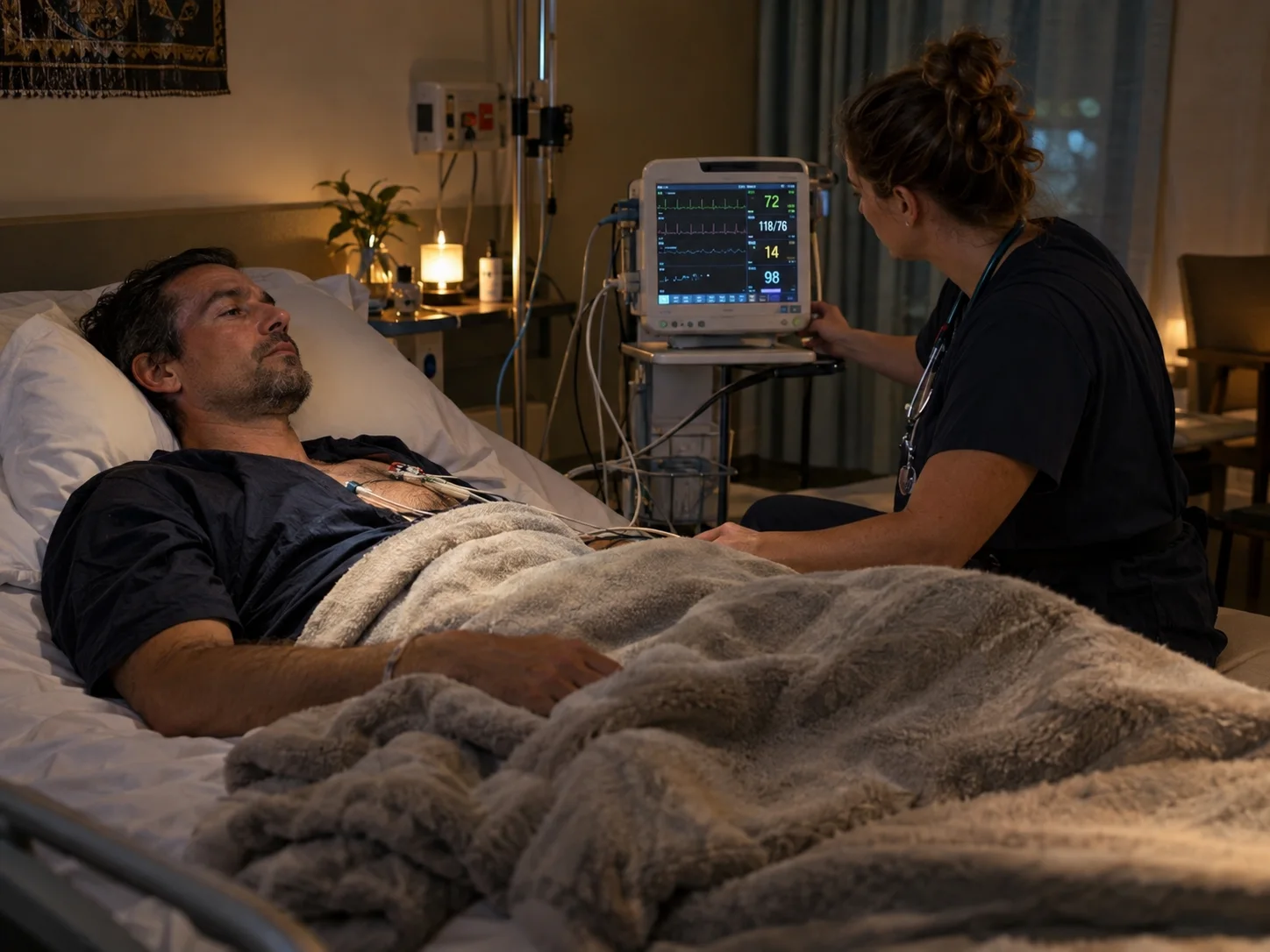
Image context
Illustrative editorial image: monitored treatment environment. Monitor graphics are synthetic and are not a diagnostic tracing.
Staffing and Scope of Practice
Role allocation, attendant posture, fatigue, handoff, fitness to practice, and relational continuity.
Staffing and Scope of Practice
Role allocation, attendant posture, fatigue, handoff, fitness to practice, and relational continuity.
Everyone in the room needs a defined job. Name who owns medical decisions, physiological monitoring, behavioral support, emergency activation, documentation, and transfer. Different jurisdictions may distribute those roles differently, but psychedelic experience alone does not cover them automatically.
| Role | Core responsibility | Escalation authority and limits |
|---|---|---|
| Clinical authorityMedical director or responsible physician | Owns medical eligibility criteria, unresolved medical risk, medication decisions, emergency medical policy, specialty consultation and transfer relationships. | Must be able to authorize postponement, additional evaluation, emergency escalation and transfer within the legal structure of the program. |
| Clinical assessmentPhysician or advanced practice clinician | Performs medical assessment within scope, reviews ECG and relevant laboratory findings, evaluates symptoms, and initiates medical treatment when authorized. | Escalates outside expertise when the finding exceeds scope or facility capability. |
| Nursing careNursing | Performs ongoing clinical assessment, medication administration within orders, IV and supportive care within scope, monitoring, symptom recognition and documentation. | Escalates physiological change promptly and follows standing emergency policy or direct orders. |
| MonitoringMonitoring personnel | Observe and document rhythm, rate, blood pressure, oxygenation when indicated, symptoms and device alarms. | Monitoring personnel require a defined route to a clinician who can interpret and act. Alarm recognition without response authority is not an adequate system. |
| SupportBehavioral or psychological support | Provides orientation, reassurance, noncoercive support, observation of mental status and communication with the medical team. | Does not independently manage medical instability or exceed mental health licensure and program scope. |
| Medication consultationPharmacy or medication support | Reviews interaction concerns, medication reconciliation, product handling and emergency medication readiness where available. | Escalates interaction and formulation concerns to the responsible prescriber. |
| Specialty consultationCardiology / toxicology consultation | Provides specialty interpretation for significant ECG, arrhythmia, toxicokinetic, interaction or poisoning questions. | Consultation should be available through a preplanned pathway when the program cannot resolve the issue internally. |
| Emergency responseEmergency response and receiving hospital | Provides higher level resuscitation, diagnostic capability and inpatient care. | The sending team should know how to activate transport and what clinical information must accompany the patient. |
EVIDENCE STATUS: Controlled studies and the pattern of serious adverse events support structured medical staffing and monitoring. The literature does not define an evidence based staffing ratio, so ratios still depend on jurisdiction, facility capability, and patient acuity.
NAMED CONTEMPORARY PROGRAM EXAMPLE: Beond’s public practitioner materials describe nursing preparation that combines ACLS, cardiac monitoring, and altered-state support, along with trauma-informed intake and individualized consent. The program also reports assigning emergency roles before a shift begins, including team leadership, airway, compressions, defibrillation, medications, and event recording. The transferable practice point is role clarity, rehearsal, and readiness before a crisis; Beond’s exact staffing pattern is not a universal ibogaine requirement.
The Attendant Posture
The person closest to the participant needs more than rhythm recognition. They need to stay calm, observant, noncoercive, and relationally steady while unusual or frightening material unfolds. General psychedelic therapy literature emphasizes trust, empathy, self awareness, and presence. Ibogaine adds a second demand: the same team must stay medically attentive and be ready to escalate when the clinical picture changes.
- Use one calm lead voice when the participant is frightened or confused.
Multiple people talking, correcting, or crowding can intensify threat perception and make it harder to distinguish experiential distress from clinical deterioration.
- Explain necessary actions before touching or repositioning whenever time allows.
Ataxia and altered perception can make ordinary care feel invasive or disorienting. Predictability preserves agency.
- Avoid arguing about the literal truth of visions or spiritual content.
Support can validate the emotional reality of an experience without endorsing a metaphysical claim or reinforcing a delusion.
- Do not force disclosure, interpretation, eye closure, music, prayer, or a particular emotional process.
The participant remains a person with preferences, not an object of a ceremony or psychotherapy script.
- Observe language, attention, orientation, motor function, behavior, breathing, and physiology together.
A dramatic subjective experience can coexist with medical instability, and a quiet participant can still be deteriorating.
- Know when to change roles from witness to clinician.
The supportive stance is subordinate to airway protection, arrhythmia management, seizure response, emergency transfer, and other objective safety needs.
Human Factors, Fatigue, and Handoff
Ibogaine sessions are long enough for staff fatigue to become a safety issue. Build the schedule around shifts, clean handoffs, closed-loop communication, and a shared record of ECG trajectory, symptoms, medications, fluid losses, mobility, mental status, and unresolved concerns. Any team member should be able to raise a safety concern immediately, regardless of seniority or ceremonial authority. Historical provider notes reinforce the operational point: Wells described remaining continuously present through very long sessions, later concluding that solo coverage was unsustainable and that future treatments should use shifts and continuous presence rather than depending on one exhausted attendant. The lesson is not to copy one provider’s schedule. It is to treat fatigue and coverage as predictable safety variables.
Provider Fitness, Transparency, and Team Governance
Ibogaine programs frequently include people whose expertise comes from medicine, nursing, psychotherapy, addiction recovery, ceremonial practice, apprenticeship, personal treatment experience, or some combination. Those backgrounds can be valuable, but none should be allowed to stand in for competencies the person does not actually hold. Participants should know who is doing what and why.
- Transparency
State role, credentials, licensure where applicable, relevant experience, limits of scope, and who owns medical decisions.
- Fitness for duty
Staff should not provide high-risk care while impaired by exhaustion, substances, acute illness, emotional dysregulation, or another condition that compromises attention or judgment.
- Lived experience
Personal recovery or ibogaine experience may increase empathy and practical knowledge. It can also create overidentification, rescue dynamics, projection, or certainty that one person’s experience applies to everyone.
- Supervision and consultation
Nonmedical providers need a defined path to clinicians. Clinicians need specialty consultation when findings exceed their expertise. Experienced facilitators also benefit from reflective supervision around boundaries and difficult cases.
- Team structure
Use written role descriptions, confidentiality expectations, handoff standards, emergency authority, and a conflict-resolution pathway. Do not leave critical responsibilities implicit.
- Learning system
Hold regular debriefs, collect staff and participant feedback, review near misses, update protocols when evidence or field experience changes, and document why a practice changed.
- Role maturation and self-assessment
Lived experience or willingness to help does not establish readiness for a facilitator role. Providers should be able to recognize when they are overidentified, emotionally saturated, working beyond training, or entering responsibility too quickly, and step back for supervision, personal work, or additional training when needed.
Enginsoy’s 2025 provider interviews found that many practitioners entered the field through their own substance-use, mental-health, or ibogaine experiences. That “wounded healer” pattern can support empathy and credibility, but it strengthens rather than removes the need for reflexivity, boundaries, supervision, and explicit role limits.
NAMED CONTEMPORARY PROVIDER COMMENTARY: Michael Higgs described beginning at The Mission Within with practical support such as transportation, dishes, towels, and helping participants to the bathroom. He also described recognizing that he had moved into helping too quickly before completing enough of his own work, stepping back, and later completing integration-coaching training before taking on a larger coaching and facilitation role. This is field commentary rather than a credentialing standard, but it gives a concrete example of role maturation, reflexivity, and the difference between lived experience and demonstrated readiness.
Continuity of Relational Support
Some contemporary programs deliberately carry a support relationship across more than one phase of care. Beond publicly describes preparation and integration coaching that begins before arrival, continues onsite, and extends after the participant returns home. The operational value is continuity of history, trust, expectations, and follow-up ownership. The Mission Within has separately described preparation coaching before treatment and integration coaching afterward. These are named program models, not evidence that one continuity structure produces superior outcomes.
In practice
Introduce incoming staff and explain the handoff when the participant can receive that information. Include preferred language, touch boundaries, privacy needs, movement triggers, and helpful reassurance alongside clinical findings. A change of shift should feel like continuity to the participant, with a clear person to call.
Expert practice · Project synthesis / non peer reviewed · Practice confidence: Expert Operational Practice
Dickinson (2016); Lotsof (2003); Wells · 8 more
View Evidence 12 sources
Continue Through the Global Competencies
Facility and Emergency Capability
Monitoring, emergency response, room design, equipment access, maintenance, and operational capability.
Facility and Emergency Capability
Monitoring, emergency response, room design, equipment access, maintenance, and operational capability.
Build the setting around the complications the team may actually have to manage. Continuous rhythm monitoring, 12 lead ECG capability, oxygen, suction, defibrillation, emergency access, electrolyte management, reliable communication, and rapid transfer need to be available at the level required by the protocol and patient population. A program that cannot provide those capabilities needs a different setting or a different plan.
| Capability domain | Clinical purpose | Evidence source |
|---|---|---|
| Continuous rhythm monitoring | Detects bradycardia, ectopy and tachyarrhythmia during periods of active physiological effect. | Used in controlled clinical safety work and directly responsive to documented arrhythmia cases. Exact duration is not established. |
| 12 lead ECG capability | Allows measurement and confirmation of rate, rhythm, conduction, QT, QTc and morphology when baseline or dynamic change requires full interpretation. | Ibogaine human studies and general cardiology. |
| Blood pressure and routine vital signs | Detects hemodynamic change and helps interpret symptoms such as syncope or presyncope. | Standard clinical monitoring plus ibogaine study practice. |
| Oxygenation monitoring when clinically indicated | Supports detection of hypoxia, respiratory compromise and aspiration related deterioration. | Toxicology cases and general clinical standards. Continuous use for every patient has not been specifically validated. |
| Oxygen, suction and airway equipment | Supports initial management of vomiting, aspiration and respiratory compromise within qualified scope. | Mazoyer aspiration case plus ordinary emergency standards. |
| Defibrillation capability | Required wherever the setting is expected to respond immediately to a shockable life threatening rhythm before EMS arrival. | General emergency standard applied to documented ibogaine ventricular arrhythmia risk. |
| IV access and emergency medication capability where appropriate | Allows qualified clinicians to treat emergencies, correct significant electrolyte abnormalities and provide supportive care. | General acute care standard. Whether prophylactic IV access is routine should be determined by clinical setting, protocol and scope rather than assumed. |
| Emergency communication and transport | Allows immediate activation of EMS and transfer to a facility capable of advanced cardiac and toxicological care. | Risk management necessity from severe case reports. |
| Backup power and monitoring plan | Prevents a loss of surveillance during utility or device failure. | Expert practice and healthcare systems safety. |
| Medication and product storage | Preserves product identity, emergency medication integrity and controlled access. | General medication safety and traceability. |
| Documentation system | Creates a time linked record of dosing, rhythm, vital signs, symptoms, decisions, consultations and transfer. | Global Competencies and general clinical practice. |
Emergency medication readiness
Before each treatment period, check that injectable magnesium, the selected seizure rescue benzodiazepine, bradycardia medications, fluid and electrolyte replacement supplies, and the selected antiemetic are accessible with written orders. Confirm the defibrillator and pacing functions, suction, ventilation equipment, IV supplies, and transfer contact. Assign responsibility for expiry checks, restocking, and repeat dose availability. The medication reference gives the indication and monitoring detail for each group.
The Room Is Part of the Safety System

Image context
Illustrative editorial image: treatment room designed to support monitoring, emergency access, privacy, and low stimulation.
Design the medical environment and the lived experience together. The room should allow privacy, quiet, physical comfort, staff observation, alarm audibility, and fast emergency access at the same time. The participant should feel cared for while the team still has room to work if the session suddenly becomes medical.
- Mobility and fall prevention
Keep walking paths clear, route monitoring cables to reduce trip hazards, make emesis supplies reachable, and plan assisted toileting before the participant becomes severely ataxic.
- Positioning and aspiration
Use a bed or surface that permits safe repositioning and rapid airway access. Staff should be able to respond to vomiting without forcing an ataxic or heavily absorbed participant to stand.
- Sensory load
Use adjustable lighting and controllable sound. Reduce unnecessary conversation, foot traffic, alarms that can be safely adjusted, and abrupt touch while preserving all medically necessary alarm functions.
- Privacy and dignity
Plan toileting, hygiene, clothing changes, observation, and visitor access before dosing. Medical observation does not require unnecessary exposure or loss of dignity.
- Emergency geometry
Do not place furniture, ceremonial objects, cables, or decorative elements where they delay access to the patient, oxygen, suction, defibrillation, or transport.
- Cultural and spiritual elements
Include only elements that fit the participant and the competence or authorization of the people using them. Never let ritual objects interfere with infection control, monitoring, airway access, fire safety, or emergency movement.
Operational Facility Safety Beyond Clinical Monitoring
- Bathroom and fall environment
Non-slip surfaces, stable grab points where appropriate, clear path, adequate light for assisted movement, and a plan for a participant who cannot safely walk to the bathroom.
- Emergency egress
Staff know exits, routes remain clear, emergency numbers and transfer information are immediately available, and the participant is not placed where equipment blocks emergency movement.
- Infection prevention
Hand hygiene supplies, cleanable equipment, appropriate waste handling, and sharps disposal if needles or IV supplies are used.
- Equipment readiness
Scheduled maintenance, battery and backup-power planning, functional checks, cleaning, and clear ownership for restocking emergency supplies.
- Communication failure
Backup phone or communication method and a plan for network, power, or monitor failure.
- Environmental dignity
Private toileting and changing options, clean bedding and clothing, odor control without strong scents, and secure storage of personal belongings.
- Staff safety
Adequate staffing for transfers, agitation, emergencies, and relief breaks. One exhausted attendant should not be the sole safety system for a prolonged session.
Historical GITA minimal standards emphasized basic environmental hazards such as bathroom slips, emergency exits, handwashing, sharps, equipment maintenance, and fire planning. Those details remain relevant because many preventable failures occur outside the ECG trace. Local facility codes and health-care regulations take precedence where they apply.
In practice
Walk through the environment from the participant’s perspective before the session. Check how they will request help, reach toileting support, and understand alarms or staff movement. Team rehearsal should also test whether emergency access remains possible when routine comfort items, chairs, and personal belongings are in place.
Expert practice · Project synthesis / non peer reviewed · Practice confidence: Expert Operational Practice
Knuijver (2022); Alper (2012); Rocha (2023) · 7 more
View Evidence 11 sources
Supportive and Emergency Medications
Continue Through the Global Competencies
Baseline Before Administration
The final clinical reference: ECG, vital signs, exposure timing, mental state, product, and team readiness.
Baseline Before Administration
The final clinical reference: ECG, vital signs, exposure timing, mental state, product, and team readiness.
Right before administration, make sure the person in front of you still matches the person who was cleared. Recheck the things that can change: recent substances, medications, withdrawal, hydration, symptoms, mental status, vital signs, ECG or labs when indicated, and the final product record. Document who makes the decision to proceed.
- Identity and consent
Correct patient, valid consent completed before intoxication, current understanding and opportunity for questions.
- Medication reconciliation
What was actually taken since the last review, including over the counter agents, supplements and nonprescribed drugs.
- Last substance use and withdrawal state
Substance, amount, route, time, current objective and subjective withdrawal findings, recent relapse or overdose.
- Vital signs
Rate, blood pressure, respiratory status, temperature when clinically indicated, and current symptoms.
- ECG
Current rate, rhythm, PR, QRS, QT, QTc formula, morphology, ectopy and comparison with prior tracing when available.
- Relevant laboratory review
Electrolytes, renal/hepatic or other studies that were clinically indicated, including what remains abnormal and who reviewed it.
- Mental status and capacity
Orientation, attention, behavior, affect, thought process, psychotic or manic symptoms, sedation, intoxication and ability to participate.
- Hydration and mobility
Recent intake, vomiting/diarrhea, orthostatic symptoms, baseline gait and any neurological abnormality.
- Product and planned administration record
Formulation, lot or batch, analytical information, calculation method, planned amount and coadministered agents. This documents the plan without creating a general dosing recommendation.
- Emergency and discharge logistics
Emergency contact, receiving facility/transport plan, discharge transportation and anticipated continuing care.
- Authorization
Name and role of the clinician making the proceed, postpone or further evaluation decision and the rationale.
- Experiential care plan
Touch and mobility assistance preferences, sensory preferences, music or silence, spiritual or secular framing, privacy, visitors, recording preferences, and the preagreed boundary between supportive presence and emergency medical authority.
In practice
Create a deliberate pause before administration to confirm both the clinical baseline and the shared plan. Let the participant raise one more question without feeling they are delaying everyone. Verify that the team knows current preferences and outstanding concerns as well as the recorded measurements.
Established clinical risk · Project synthesis / non peer reviewed
View Evidence 3 sources
Continue Through the Global Competencies
Acute Monitoring
Follow cardiovascular, respiratory, neurological, withdrawal, hydration, and behavioral changes over time.
Acute Monitoring
Follow cardiovascular, respiratory, neurological, withdrawal, hydration, and behavioral changes over time.
Monitor closely enough to see the change before it becomes a crisis. Continuous rhythm observation belongs in the acute period, and repeat 12 lead ECGs often enough to show the QT and rhythm trajectory. In Knuijver’s protocol, ECGs were obtained every 30 minutes for the first 12 hours, then adjusted according to QTc behavior, with cardiology review at 24 hours. That schedule comes from one research protocol, but it gives a useful published benchmark for the intensity of monitoring used with a known QT active exposure.
Image context
Illustrative editorial image: monitored treatment environment. Monitor graphics are synthetic and are not a diagnostic tracing.
| System | Monitor | Change that deserves reassessment |
|---|---|---|
| Cardiovascular | Continuous rhythm where the clinical protocol calls for it, heart rate, blood pressure, symptoms, repeat 12 lead ECG when indicated, QT trajectory and ectopy. | Increasing repolarization abnormality, new ventricular ectopy, pauses, marked bradycardia, tachyarrhythmia, chest pain, syncope or presyncope, unexplained hypotension. |
| Respiratory | Respiratory rate, work of breathing, airway protection, oxygenation when indicated and aspiration signs. | Unexpected hypoxia, reduced respiratory effort, inability to protect airway, repeated emesis with declining consciousness, abnormal lung findings. |
| Neurological | Level of consciousness, orientation, ataxia, motor activity, tremor, seizure, focal findings and ability to move safely. | Seizure, new focal deficit, persistent or worsening altered consciousness, ataxia that exceeds the expected trajectory or creates injury risk. |
| Psychiatric / behavioral | Distress, fear, agitation, confusion, disorientation, impulsivity, psychotic symptoms, suicidality and behavioral control. | Severe agitation, dangerous behavior, loss of capacity with emerging risk, prolonged confusion, psychosis or manic activation outside the expected acute altered state. |
| Gastrointestinal | Nausea, vomiting frequency, ability to protect airway, intake and fluid loss. | Persistent vomiting, hematemesis, signs of dehydration, aspiration concern or inability to maintain hydration. |
| General physiology | Temperature when relevant, hydration, mobility, urination, nutrition when appropriate and pain. | Fever, inability to void, persistent orthostasis, severe weakness, injury, progressive dehydration or other evidence of acute illness. |
| Withdrawal | Objective and subjective withdrawal course relative to substance history. | Unexpectedly severe or atypical withdrawal, alcohol or benzodiazepine withdrawal signs, persistent uncontrolled symptoms or need for higher level addiction care. |
| Experiential / relational | Ability to communicate needs, trust in the care team, response to touch and stimulation, degree of inward absorption, frightening or adversarial interpretations, and whether the person can reorient when invited. | Abrupt loss of trust, escalating paranoia, inability to reorient, dangerous attempts to leave or fight care, rapidly worsening confusion, or experiential change accompanied by physiological instability. |
Practice note: no single monitoring schedule has been validated across all formulations and patient types. Use the Knuijver protocol as a published benchmark and make the local schedule responsive to QT, rhythm, symptoms, and overall clinical change.
In practice
Use predictable explanations for repeated observations: say what you are checking and whether the person needs to do anything. Keep one person listening while another records or assesses when staffing allows. Changes in conversation, expression, or behavior belong alongside objective findings in the clinical account.
Established clinical risk · Project synthesis / non peer reviewed
Knuijver (2022); Knuijver (2024); Hildyard (2016) · 4 more
View Evidence 8 sources
Continue Through the Global Competencies
Respiratory, Airway, and Aspiration Safety
Sedative and opioid coexposure, airway protection, aspiration, oxygenation, and escalation.
Respiratory, Airway, and Aspiration Safety
Sedative and opioid coexposure, airway protection, aspiration, oxygenation, and escalation.
Watch breathing, level of consciousness, airway protection, and aspiration risk, especially when opioid or sedative exposure, vomiting, or abnormal sedation is present. Use pulse oximetry, capnography, suction, oxygen, airway support, or emergency escalation according to clinical indication and setting capability. Do not interpret abnormal breathing as part of the psychological process.
- Responsibility
- Facilitator · Clinical team
- Applies in
- Medically supervised administration · Research setting
Ibogaine is not primarily a respiratory depressant in the way opioids or sedative hypnotics are, but the population receiving it often brings respiratory risk into the room. Recent opioid or sedative exposure, repeated vomiting, impaired coordination, reduced consciousness, aspiration, seizure, and rescue medications can all change airway safety. A quiet participant with an inward focus still requires observation of breathing and the ability to protect the airway when clinical context makes that concern relevant.
Respiratory support should be proportionate to the person and the exposure. Observe respiratory rate and effort, positioning, consciousness, emesis, and oxygenation when indicated. Pulse oximetry is useful when opioid or sedative coexposure, aspiration, hypoxia, or other respiratory concern is present. Capnography can be appropriate when clinically significant sedation or respiratory depression is a concern and the setting is equipped to interpret it. Neither tool replaces direct observation.
Vomiting changes the problem when the person cannot reposition independently, cannot protect the airway, becomes progressively sedated, develops hypoxia, or has abnormal lung findings. The facilitator should know how to summon medical help immediately and should not interpret coughing, hypoxia, or reduced responsiveness as part of the psychological process.
| Risk context | What to watch | Escalation logic |
|---|---|---|
| Recent opioid or sedative exposure | Clarify timing, amount, current sedation, respiratory rate and ability to protect airway. | Escalate when respiratory depression, hypoxia, or unreliable airway protection exceeds the setting. |
| Repeated vomiting | Position and supervise for airway safety, keep suction available when the medical setting uses it, track consciousness and respiratory findings. | Aspiration, hypoxia, declining consciousness, or inability to manage fluid loss changes the level of care. |
| Seizure | Protect from injury and assess airway and breathing after the event. | Recurrent seizure, status epilepticus, persistent altered consciousness or respiratory compromise requires emergency level evaluation. |
| Rescue medication | Account for sedation and respiratory effects when choosing medication. | A medication used for agitation or nausea should not create an unrecognized airway problem. |
| Prolonged immobility | Reassess positioning, comfort, breathing and need for assistance rather than assuming stillness equals stability. | New respiratory symptoms, pain, focal findings or pressure related problems require clinical evaluation. |
In practice
Anticipate that repositioning, oxygen, or additional staff may feel intrusive in an altered state. Explain briefly when possible, assign a calm voice, and preserve privacy while clinicians address the airway or breathing concern. Necessary urgent care takes priority, with explanation and reassurance continuing as circumstances permit.
Established clinical risk · Project synthesis / non peer reviewed
View Evidence 4 sources
Continue Through the Global Competencies
Read the Rhythm, Not Just the QTc
Manipulate rhythm and morphology, compare QT corrections, examine pauses, and test your interpretation.
Read the Rhythm, Not Just the QTc
Manipulate rhythm and morphology, compare QT corrections, examine pauses, and test your interpretation.
- Responsibility
- Clinical team
- Applies in
- Medically supervised administration · Research setting
Original teaching schematics · Project synthesis / non peer reviewed
A rhythm can look profoundly abnormal and remain organized. A less dramatic tracing can become dangerous when it stops being stable. Watch the change.
Static teaching sequence and text alternative
- Organized repolarization delay
- Prolonged repolarization with an organized rhythm and consistent morphology. Risk is not zero, and stability does not override established QT warning markers.
- Dynamic repolarization instability
- Changing morphology, pause dependence, beat to beat variability, and new ventricular ectopy warrant reassessment.
- Malignant ventricular arrhythmia
- Polymorphic ventricular tachycardia or torsades with loss of organized activation is an emergency requiring established resuscitation standards.
In practice
Use this teaching module during training or preparation for professional practice. Discuss what the schematic shows, what it omits, and how a real assessment also depends on history, symptoms, serial tracings, and the clinical setting. The learner should leave with clearer questions for a qualified clinician rather than a patient-specific verdict.
Established clinical risk · Project synthesis / non peer reviewed
Knuijver (2022); Knuijver (2024); Hildyard (2016) · 8 more
View Evidence 12 sources
Continue Through the Global Competencies
Team responsibilities by phase
Administration and Acute Monitoring
| Clinical goal | Information required | Main risks | Required decisions | Documentation |
|---|---|---|---|---|
| Detect expected effects and clinically important deviations early enough to respond. | Product and amount administered, time, baseline findings, rhythm, rate, blood pressure, mental status, ataxia, vomiting, withdrawal symptoms, interventions. | Dynamic QT change, marked bradycardia, ventricular ectopy, syncope, aspiration, seizure, altered consciousness, severe agitation. | Continue planned observation, intensify monitoring, obtain 12 lead ECG or labs, consult, or activate emergency transfer. | Time stamped administration and monitoring record, objective changes, interpretation, interventions and response. |